Shahmaran and Shahapet: The Snake Cults of the Kurds, Yazidis, and Armenians
Ancient Snake Cults
Ancient Egypt assigned the opposing characteristics of good and evil, knowledge, power, and destruction to different snake gods. The snake goddess Vadjet was worshipped as early as pre-dynastic times. Her symbol was the uraeus. She is considered the goddess of Lower Egypt and, together with Nekhbet, the goddess of Upper Egypt, is the protective goddess of the king (pharaoh). The Egyptians also knew the serpent god Mehen, who protectively encompassed the sun god Re on his night journey through the underworld. Since the Middle Kingdom, belief in the god Apophis has also been documented. Depicted as a giant serpent, this god embodied dissolution, darkness, and chaos. He was also the great adversary of the sun god Re.
In ancient Greece, the snake was considered sacred. Since it could renew itself infinitely often in the eyes of humans through regular molting, it was considered immortal. This constant act of rejuvenation and the fact that snakes were believed to have healing powers made them a symbol of the medical profession. To this day, it has remained the symbol of the rod of Asclepius, which, in a greatly simplified form, can also be found in some pharmacy signs. Snakes were also said to have clairvoyant powers, which is why they were one of the animals of the goddess Gaia, one of the first deities after the original chaos. Snake priestesses (Pythea) performed their duties at the Oracle of Delphi. which once belonged to the mythological serpent Python and was considered the navel (omphalos) of the world. Python was killed by the god Apollo, who then took over the sanctuary and its priestesses.
It was not only in the Judeo-Christian tradition that there was a tree guarded by a snake: in ancient Greek mythology, the garden of the Hesperides contained the life-giving apple tree, which had been bestowed upon the goddess Hera by Gaia and was guarded by the snake Ladon.
In the Near East, the Levant, the Golden Crescent, Mycenaean culture, and many other cultural areas of Western Asia, snake cults were of great importance in the Epipaleolithic and Neolithic periods. Every deity was associated with representations of snakes, especially on reliefs and ceramics.
The Old Testament of the Bible, on the other hand, views the snake almost entirely in a negative light. The snake presents Eve with the forbidden fruit and tempts her to violate the divine prohibition against eating from the tree of the knowledge of good and evil, before Eve persuades Adam to break the taboo as well.
In the Bible, the snake is largely a symbol of the devil. In the story of Paradise (Genesis 3) in the Old Testament, the snake is a symbol of temptation and seduction into evil. Only in some Gnostic sects were Eve and the snake revered for the knowledge they provided to humans (where the snake was sometimes depicted as Eve’s male companion, Ophion).
As the people of Israel wander through the desert, they are plagued by snakes (Numbers 21); Moses is told to raise up a bronze snake, and everyone who looks up at it will be saved. Here, the snake (like the cross for Christians) appears as a sign of salvation. In 2 Kings 18:4, it is reported that this bronze serpent, called “Nehushtan,” was preserved until the time of King Hezekiah; but because it was worshipped as an idol, Hezekiah smashed it.
Even though Jesus advises his disciples, “Be wise as serpents and harmless as doves!” (Matthew 10:16), in the Book of Revelation, the serpent remains an image of evil: “And he seized the dragon, that ancient serpent, who is the devil and Satan” (Revelation 20:2 EU).
Yazidi Serpent Symbolism
In the Yazidi religion the serpent has long been a symbol laden with meaning. Any visitor to Lalish in Northern Iraq will engrave in their memory of the first thing they saw, an image of a massive black snake that welcomes them upon entry into the courtyard of the Yazidi main sanctuary.
The Yazidi religious tradition, rooted in ancient Mesopotamian beliefs and influenced by Zoroastrianism, Islam, and Christianity, encompasses various symbols, among which the serpent holds a prominent position. The Yazidis associate the serpent with wisdom, knowledge, and the divine. The snake is often seen as a symbol of creation and fertility, as well as a representative of cosmic forces and the transcendent. In Yazidi cosmology, the serpent plays a role in the creation of the world and is associated with the deity Tawûsî Melek, also known as the Peacock Angel. The Peacock Angel, often depicted with serpents, is considered both a benevolent figure and a bringer of knowledge.
Representing wisdom, creation, and the divine, the serpent holds a central place in Yazidi rituals and traditions. It is believed that the snake possesses healing powers, and Yazidis revere them as intermediaries between humans and the divine. Snakes are often kept in Yazidi shrines, and their presence is believed to bring blessings and protection. Yazidi religious practices also involve snake handling and dances, where participants express devotion and seek a spiritual connection with the divine through the serpent’s symbolic presence. (Bozyel 2023)
The Kurdish Snake Goddess Shahmaran
Shahmaran is a mythical creature, half-snake and half-woman, portrayed as a dual-headed being with a crown on each head, possessing a human female head on one end, and a snake’s head on the other, possibly representing a phallic figure (Baran 2020, 92f.). The human part is decorated with a large necklace. Together with snakes, she lives in the Underworld/Otherworld.
The name Shā(h)mārān (Shaymaran; Turkish Shahmeran) derives from the Persian words Shāh (شاه), and mārān (ماران; transl. ‘snakes’; sg. مار mar). Hence, Shāhmārān literally means ‘the king/ruler of snakes’ (Russell, 1987, 422).
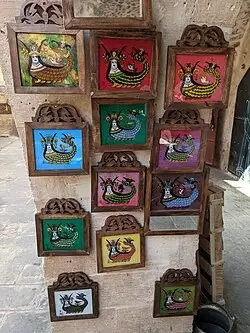
In Turkey, Shahmaran is believed to live in the Mediterranean town of Tarsus, and a similar legend is told in the eastern portion of the country, namely Mardin, a town with a large Kurdish and Arab population. In these regions her legend is commonly evoked, with her image depicted in embroidery, fabrics, rugs, and jewelry. The story and imagery of Shahmaran are considered a national treasure in Turkey. Kurds have traditionally viewed the serpent as a symbol of luck and strength, and they continue to have images of the goddess Shahmaran on glass or metal work, which is in turn displayed on their walls.
Kurdish scholar Dilşa Deniz interprets Shahmaran as an androgyn “body of sacred unity”: “… the whole is built from a series of contrasts or dualities: human/animal, woman/man, feminity/masculinity, death/rebirth. Despite the apparent physical contrast of two seemingly incompatible creatures, perfect balance is achieved.
As they are forged into a single entity at the opposite ends of each body, the Shamaran image and myth represent the perfect map showing how dualistic balance is achieved. Alongside the female part, the masculine is represented by the features of the snake: strong long neck, plain style of adornment, the ruler’s crown atop the head, and the snake’s stance as a protector” (Deniz 2023, 110f.) of the human, female part of Shahmaran.
Shahmaran is attested in Middle Eastern literatures, such as in the tale “The Story of Yemliha: An Underground Queen” from the 1001 Arabian Nights, and in the Camasb-name. Her story seems to be present in the Eastern part of the Anatolian peninsula, or in southeastern and eastern Turkey (comprising areas of Kurd, Arab, Syriac and Turkish communities) (Baran 2020, 92).
Due to its antiquity of perhaps 5,000 years, there are many variations of the myth of Shamaran. In one version, the first human Shahmaran encounters is a young man named Jamasp (Persian: Jāmāsp جاماسپ), who is also known by Yada Jamsab (other spellings are Jambs, Camasb, and Jamisav). Jamasp gets stuck in a cave after he tries to steal honey with a few friends. His friends leave him alone in the cave. He decides to explore the cave and finds a passage to a chamber that looks like a mystical and beautiful garden with thousands of off-white colored snakes and the Shahmaran living together harmoniously. At this point Shahmaran and Jamasp fall in love and live in the cave chamber, and the Shahmaran teaches him about medicines and medicinal herbs. But Jamasp misses living above ground and wants to leave. So, he tells the Shahmaran he will not share the secret of her living there. Many years pass.
The king of the town of Tarsus becomes ill and the vizier discovers the treatment of his condition requires Shahmaran’s flesh. Jamasp tells the townspeople where Shahmaran lives. Unlike Jamasp, Shahmaran remains faithful to her human lover and even makes him the heir to her divine wisdom: According to the legend Shahmaran says, “blanch me in an earthen dish, give my extract to the vizier, and feed my flesh to the sultan.” They bring her to the town and kill her in a bath called, “Şahmaran Hamam”. The king eats her flesh and lives, the vizier drinks the extract and dies. Jamasp drinks the water of Shahmaran and becomes a doctor, by gaining Shahmaran’s wisdom.
The Armenian Snake Cult
The Armenian veneration of snakes as symbols of power, water, and wisdom is shared with other cultures in the ancient Near East and Mesopotamia. The Armenians living in Dersim and other regions not only shared the Yazidis’ and Kurds’ nature-based snake worship, but also saw themselves as relatives of the endemic grass snake (Natrix natrix; Armenian: Սովորական լորտու,Կողինջ – Sovorakan Lortu, Korindj; Western Armenian: Lordu. – Common grass snake) (Սովորական լորտու).
Snakes play an important role in the nature and culture of the Armenian highlands. Remnants of a pre-Christian snake cult persisted into the 20th century, for example in the ancient city of Ashtarak on the edge of the Ararat plain. The grass snake, which is non-venomous to humans and can grow up to 120 cm long depending on its age, was also kept as a pet snake. Similar to the ancient Roman Manes, they were considered protectors of the house, the hearth, and the family, but also of an entire region, reflecting the belief in the snake as the totem animal of the Armenians. Armenians saw the grass snake as related to them and also considered it to be Armenian, friendly to the Armenians as a blood relative (Hofmann & Koutcharian, 1983, 127). If a house snake left its home, this was considered a bad omen. The skins that snakes shed during molting were kept as talismans and good luck charms.
In ancient Armenian folk beliefs, snakes were revered as sacred and protective symbols, not as a unified cult. These beliefs involved harmless domestic snakes (lortu/lordu) seen as guardians of the home, bringing good luck and fertility. Moreover, Armenians worshipped the harmless lortu and called it “hay” (corresponds to the Armenian ethnonym “hay”). The equation of the Armenian ethnonym with snakes or Armenians is also found in other ancient cultures: Sumerian god of wisdom and keeper of records, Haya, was portrayed as a snake. Bedouins called snakes “haya”.
The lortu/lordu were considered protectors that chased away evil spirits and defended their human relatives against poisonous snakes. As a totem for Armenians, the lortu appears in myths as a friendly, benevolent guardian spirit called “shahapet” (“shah-a-pet”, “literally “head of the Shah(s)”. If treated kindly, they would leave gold, if not, they would bring strife and mischief.
Additionally, the powerful dragon-like vishap symbolized water and storms in mythology. In some myths, vishap lived in primordial waters and waged war with mountain-dwelling snake kings, with their battles causing storms.
Images of snakes were popular in art, rug weaving, adornment, and place names. Snakes were a common motif carved on house pillars, furniture, and on jewelry, symbolizing fertility and protection. Women wore ornaments in the form of a snake because snakes were also a symbol of fertility. Numerous place names such as Odzun and Odzaberd (“snake fortress”), Odzi get (“Snake river”), Odzi Kaghak (‘Snaketown’), etc. are derived from the Armenian word for snake (“odz”). Armenian folk tales tell of Odzmanuk, the snake youth, who, like the snake deity Shahmaran, is half human and half snake. We also encounter the motif of the snake ruler who bequeaths his brain and thus his omniscience to a human successor.
It was believed that leaving milk out for the grass snakes would result in them leaving gold in return. Their presence was a sign of good fortune, and mistreating them was thought to bring misfortune and loss. This element of snake worship is also found among Baltic peoples: in their pre-Christian religion, snakes, like toads, played a significant role. Every family considered itself lucky if a grass snake settled in the fireplace, in the bathhouse, or under the hand mill. They were fed like pets with eggs and milk, and people watched carefully to see if they accepted the food. In Lithuania, snake charmers, Žaltones (from the Lithuanian žaltys, “grass snake”), are part of tradition.
After the adoption of Christianity, the snake cult in Armenia gradually disappeared, with the exception of remote areas. In stark contrast to Lithuania, which has rediscovered the ancient Baltic worship of snakes and erected monuments to snakes in many places, featuring both crowned and uncrowned snakes, the endemic grass snake is now often kept in captivity in Armenia. The “shahapet,” once revered as a totem animal and a relative, has become a “farm animal” abused for research purposes (Sovorakan lortu).
Conclusion
The worship of snakes, especially non-venomous snakes, as wise and healing protective and household deities is one of the oldest beliefs. With the advent of monotheism, the view of snakes changed, and was replaced by a sharp dualistic separation of good and evil. This was already the case in ancient Iranian Zoroastrianism, in which the snake lost its role as protector and became in instrument of destruction of the vulnerable tree of life, Gaokerena. Ahriman, the evil counterforce to the divine creator Ahura Mazda, attacks the tree by sending frogs and snakes to poison it. With the Creation account in the Old Testament of the Bible (1st millennium BE), the human view of snakes shifted even more radically: from a protective deity who guarded the tree of the Hesperides in ancient Greece, it became a satanic tempter.
A comparison of the cultures and beliefs in Kurdistan and the Armenian Highlands, as well as in the east and southeast of present-day Turkey, shows that the original, pre-Abrahamic nature-based beliefs have been preserved most consistently in the Yazidi faith. This is the more remarkable as the Yazidi belief is otherwise influenced by Zoroastrism and Islamic beliefs. In the Kurdish belief system, the myth and image of Shahmaran testify to the continued existence of elements of nature-based religion beyond Islamization. The same applies to the Christianized Armenians, whose totem and protective animal, the common grass snake, remains “Shahapet” even centuries after Christianization, especially in remote and protected mountain regions such as Dersim.
Baran, Suat. 2020. “From Fairytale Character to Lost Goddess: The Archetypal Representation of Stepmother within Kurdish Folklore.” İçinde Kurdish Art and Identity: Verbal Art, Self-definition and Recent History, editör Alireza Korangy, 92-93. Berlin ve Boston: De Gruyter.
https://doi.org/10.1515/9783110599626-004.
Deniz, Dilşa. 2023. “Shamaran (Shahmaran): The Lost Goddess of Kurdistan.” İçinde Maternal Thinking: Gifts, Mothers’ Bodies, and Earth, editörler Sid Reger, Mary Jo Neitz, Denise Mitten ve Denise Clunie, 103-119. Proceedings of the Association for the Study of Women and Mythology, Cilt 4. Brooklyn, NY: Women and Myth Press.
Deniz, Dilşa. 2020. “The Shaymaran: Philosophy, Resistance, and the Defeat of the Lost Goddess of Kurdistan.” The Pomegranate 22 (2): 222-224.
https://doi.org/10.1558/pome.38409.
Hofmann, Tessa, ve Gerayer Koutcharian. 1983. Die Nachtigall Tausendtriller: Armenische Volksmärchen. Berlin: Edition Orient.
Russell, James R. 1987. Zoroastrianism in Armenia. Cambridge, MA: Harvard University Press.
“Sovorakan lortu (Սովորական լորտու).” Wikipedia, Son erişim tarihi [15.12.2025].
License information
© The Author(s). Unless otherwise stated, entries published in the Alevi Encyclopedia are licensed under a Creative Commons Attribution 4.0 International License.