The Religious Calendar in Dersim Alevism (Raa Haqi): Gağan, Xızır/Hızır, Black Wednesday (Kara Çarşamba), and Hawtemal/Heftemal
Introduction[i]
In March, an important observance known as Hawtemal/Heftemal is celebrated by Alevis in Dersim and the surrounding provinces. Among speakers of Kırmancki, this day is referred to as Hawtemal (also rendered as Hautemal or Houtemal), while Kurmanci speakers call it Heftemal (Haftemal). The term hawt or heft means “seven,” whereas mal is generally translated as “house” or “family.”
The timing of Hawtemal/Heftemal and the qualifiers attached to it vary by region. Dedicated to welcoming the arrival of spring on 21 March-and, according to older traditions, the beginning of the new year-this observance is notable for being celebrated with different dates and designations even in geographically close areas. Beyond Dersim, Hawtemal/Heftemal is known under these names among Kurdish Alevis living particularly in Koçgiri (Sivas), Erzincan, Bingöl, Erzurum, Varto, Sarız, Gümüşhane, and Kars. In some regions, it is marked under three different dates and names-qız/quçik (small), wertên (middle), and pil/mezin (large)-while in others it is observed in two forms only, as “small” and “large.” For example, in the Koçgiri region it is celebrated in two phases, Heftemala Quçik and Heftemala Mezin. In contrast, in Dersim it is designated by three names: Hawtemalo Qız (Small Hawtemal), Hawtemalo Wertên (Middle Hawtemal), and Hawtemalo Pil (Large Hawtemal). In the Varto area, as in Koçgiri, it is likewise divided into small and large Heftemal. As will be discussed below, the dates assigned to these celebrations also vary.
In fact, the confusion surrounding dating is not limited to Hawtemal/Heftemal alone. All of the major observances encountered in these regions-such as Gağan, Hızır, and Black Wednesday (Kara Çarşamba)-face similar issues of timing. The dates of the Hızır fast, for instance, may differ from one locality to another, and multiple dates can likewise be reported for Black Wednesday. Unlike Hawtemal/Heftemal, however, these days are not designated with different qualifiers: even when observed on different dates, there is only one Hızır Fast, and one does not encounter distinctions such as a “Small” or “Large” Hızır Fast. With Hawtemal/Heftemal, precisely this multiplicity is at issue. While one would normally expect the first day of the new year to correspond to a single date, the presence of two or even three different days makes this phenomenon far from self-evident.
Sacred Days
At the outset, it should be emphasised that what is described here as a “problem” does not imply something “incorrect.” On the contrary, as will become clear in the course of the discussion, all of the differing dates encountered reflect traces of past traditions and historical transformations. In order to explain this, it is necessary to address briefly these important days other than Hawtemal/Heftemal.
Khalo Gağan
Khalo Gağan (Elder Gağan). Following 21 December, which marks the beginning of winter, fasting is observed on the first Tuesday, Wednesday, and Thursday thereafter. The fast is concluded on Thursday evening with a celebration. On this evening, an entertaining performance featuring the distinctive figures known as Alık and Fatık takes place. Children, accompanied by loud noises, go from house to house collecting food; meals are then prepared from these offerings and shared communally. Fires are lit, and the festivities continue in a lively manner until late at night. In the Dersim region, Khalo Gağan generally coincides with the last Thursday of December.[ii] In some localities, however, this festival is celebrated at the beginning of January.[iii] Gağan also marks the day on which dervishes begin their forty-day çile period (çile referring to a ritually significant forty-day phase).
Xızır/Hızır
This immortal figure is primarily known as the saviour in times of distress. The fast observed for Hızır, the cem ritual held in his name, and the sacrificial offerings made for him occupy a central place within the belief system. Most commonly, the Hızır fast lasts three days; in some regions, however, it is observed for seven days. Unmarried young people refrain from drinking water after the fast on Thursday; it is believed that the person who gives them water in their dreams that night will be the one they marry. Although in recent years Alevi institutions in Turkey have designated 13-15 February as the dates for the Hızır fast,[iv] there is a widespread understanding that it properly falls on 30 January.[v] In practice, however, the Hızır fast extends over a period of nearly a month: it begins after the second week of January and is observed sequentially in different localities, continuing until the third week of February.[vi] Two explanations are commonly offered for this pattern: first, that Hızır, being old, cannot reach all places at once; and second, that the pirs who participate in the cem held at the conclusion of the Hızır fast can only do so by spreading their participation over several weeks. With the beginning of the Hızır fast, dervishes also bring their forty-day çile period to an end.[vii] Their participation in the Hızır Cem adds an additional dimension to the ritual.
Çarseme Şai/Çarşemiye Reş (Qêre Çarseme)/Black Wednesday (Kara Çarşamba)
Although it is generally given as the first Wednesday of March, there are also regions that take the second Wednesday, or the Wednesday preceding Hawtemal/Heftemal, as the reference point.[viii] It is defined as an inauspicious day, against which a number of rituals are performed. Talips are passed three times through a ring made from the branches of rosehip (Şilan). Houses and stables are ritually cleansed with water (apsu) against the evil eye and misfortune. Likewise, cords are tied in order to avert possible harm. In some places, stones representing the members of the household are placed on rooftops or around haystacks. In the morning, it is believed that whichever stone has an insect beneath it indicates that the person it represents will have a fortunate year. It is also stated that Black Wednesday was the day on which Ana Fatma received the news of the events of Karbala. Some people observe a one-day fast in order to share in her mourning. According to the narrative, when Ana Fatma heard the news, she was boiling water in a cauldron to wash clothes; upon receiving the news, she overturned the cauldron. For this reason, no laundry is washed and no bathing takes place on Wednesdays.
Hawtemal/Heftemal
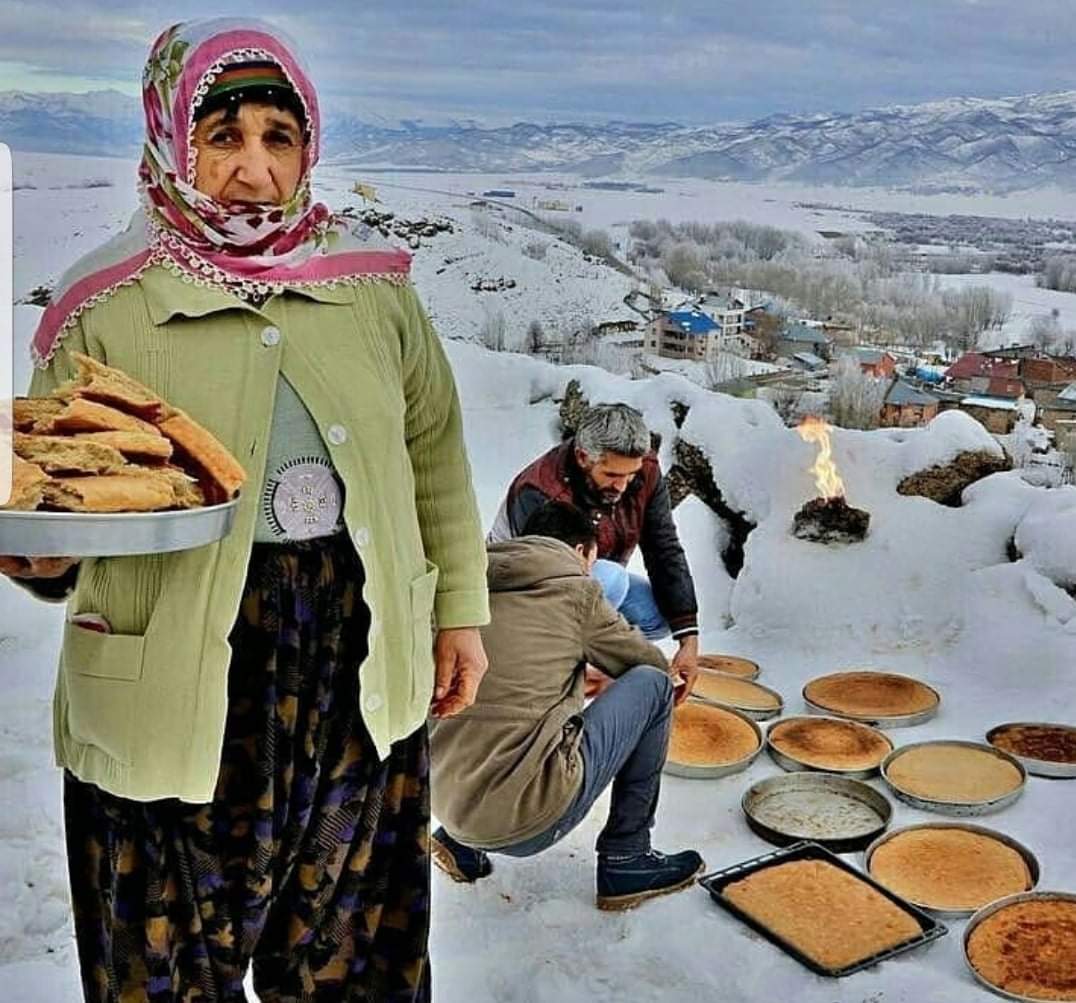
Hawtemal/Heftemal is celebrated within a broad time frame corresponding to the beginning of March and April. In some parts of Dersim, the three Hawtemals are assigned respectively to the first, second, and third Thursdays of March; the third Thursday falls on 20-21 March or on dates close to it. In other areas of Dersim, the small, middle, and large Hawtemal are associated respectively with 7, 17, and 21 March. In the Koçgiri region, the first Heftemal is accepted as 20 March, while the large Heftemal is observed on 30 March. In Varto as well, Heftemal is celebrated after 30 March.[ix] On this day, it is believed that life begins anew and that everything enters a state of reverence. Thorough household cleaning is carried out, the household starter (maya) is renewed, and after bathing with water brought from a flowing stream, clean clothes are worn. Cemeteries are visited collectively, prayers are recited, and offerings (lokma) are distributed.[x] Upon returning to the village, people share a communal meal. Rituals also performed on Black Wednesday-such as passing through a ring made of rosehip branches or placing stones on rooftops-are likewise carried out during Heftemal.[xi]
Newê Marti/Nehey Mardi
This day falls on 22 March, corresponding to the day following the conclusion of Hawtemal/Heftemal. As it is the first day after 21 March, a one-day fast is observed as an expression of gratitude.[xii]
It should be noted that the days and festivals listed here are not observed among other Alevi communities in Anatolia. Among them, only Hızır occupies a high status across all Alevi groups, yet the practice of fasting in his name during January-February is absent in most of them. Among Anatolian Alevis, the festival of Hıdırellez, celebrated on 5-6 May in association with Hızır, is described as a spring festival and a day of wishes.[xiii] The Hıdırellez festival, or the dates 5-6 May, does not form part of the traditional festive calendar of Dersim and is in fact largely unknown there. Hızır is a highly significant figure for Arab Alevis in the Hatay region as well; however, among them, belief in Hızır is expressed not through fasting but around shrines and pilgrimage sites.[xiv] Likewise, 21 March is commemorated by some Alevi groups-most notably Bektashis-under the name “Sultan Nevruz” as the birthday of Ali. On this day, prayers are recited in his name and cem rituals are held.[xv]
Accordingly, the information presented here derives from compilations concerning Dersim and communities connected to this region. It should be borne in mind that this belief community lacks centralised institutions. Moreover, even where central structures exist, it is well known that until relatively recently it was not easy to determine dates on the basis of astronomical or climatic conditions, and that this posed difficulties for many belief communities in establishing the calendars of religious festivals. We possess limited knowledge of the criteria by which people in the region-especially in remote areas-sought to determine time in the past. Nevertheless, it is evident that certain rules were applied with regard to the dates presented here.
The first of these concerns the fact that concluding ceremonies are always held on Thursdays. For this reason, fasts and festivals are observed by taking as their reference the Thursday following (or sometimes preceding) the designated day. Thus, for example, whether 21 December falls on a Thursday does not constitute a problem: the fast is in any case begun on the first Tuesday thereafter and concluded on Thursday. Likewise, the specific weekday on which 30 January falls is of no consequence; fasting may be observed on the Tuesday-Wednesday-Thursday preceding or following that date.
Another noteworthy feature relates to the determination of dates by counting back from the final day. For this reason, instead of 21 March, when spring begins, 20 March-the last day of winter-is marked; that is, according to the Rumi calendar, rather than indicating 8 March as the first day of the new year, the final day, 7 March, is specified. This means that ceremonies or celebrations are initiated on the preceding night.[xvi]
Finally, it is evident that a significant portion of the religious days observed by Alevis in the region-excluding the fasts of the Twelve Imams-take place during the winter season. The winter period opens with Khalo Gağan on 21 December; toward its end, around 20 March, one encounters Black Wednesday, Hawtemal/Heftemal, and Newê Marti. Since the Hızır fasts are observed forty days after Gağan, and Hawtemal/Heftemal is celebrated ninety days later, the starting date of Gağan naturally also determines the timing of the Hızır fast and of Hawtemal/Heftemal.
It is clear that the winter period occupied the community to a considerable degree and played a decisive role in the determination of significant days. In order for life to continue, it was necessary to endure this season, characterised throughout the region by severe cold, long nights, restricted mobility, and reliance on provisions accumulated through the labour of the entire year. Moreover, the challenge extended beyond human survival alone: feeding livestock and bringing them safely into spring constituted a problem of a magnitude difficult to imagine today. For this reason, in order to determine how the dates of these sacred days were established and whether there is an interrelationship among them, it is necessary to examine calendars and winter traditions more closely.
When elders in the region assign dates to religious days and festivals, they make reference to three calendars. The first is the Hijri calendar, which is used exclusively to determine the fasts of the Twelve Imams. For the days and festivals listed above, however, the Rumi calendar (also known as hesabê khan or “the old calculation”) and the Gregorian (Miladi) calendar come into play. There is a difference of thirteen days between the Rumi and Gregorian calendars. Accordingly, 7 March according to the Rumi calendar-given for the small Heftemal-corresponds to 20 March in the Gregorian calendar, while 17 March according to the Rumi calendar-associated with the large Heftemal-falls on 30 March.
Winter Calendar
Alongside these observances, there also exist folk calendars that incorporate experiential knowledge related to nature and climatic conditions. According to the dominant traditional understanding in Anatolia, the year was divided into two seasons: summer, which begins on 6 May, lasts 186 days, and is called Hızır; and winter, which begins on 8 November, lasts 180 days, and is known as Kasım. The final ninety-day period of winter is further divided into distinct phases. The first forty-day phase, beginning on 21 December, is called çile (also rendered as çele) or zemheri. The term çile derives from çel (çhel), meaning “forty” in Kurmanci and Persian.
The first çile period is generally recognised everywhere. With regard to the second part of winter-that is, the remaining fifty days-different forms of periodisation are encountered: (1) a single block of fifty days; (2) forty plus ten days; (3) twenty plus thirty days; and (4) twenty plus forty days. These divisions are presented according to the Rumi and Gregorian (Miladi) calendars in Tables 1 and 2.
It is useful to examine these four possibilities more closely, since the ways in which the ninety-day winter season is subdivided provide important clues for understanding the sacred days discussed here.
1) 40-50
Various researchers have noted that, in the folk calendars used across Anatolia, a periodisation of the winter season into forty plus fifty days is encountered. The first phase is called Zemheri or Erbain (from Arabic arbaʿīn, meaning forty), while the second is known as Hamsin (from Arabic, meaning fifty).[xvii] If this division is taken as a basis, it helps clarify at least three important sacred days. Gağan begins on 21 December; forty days later comes Hızır; and fifty days after Hızır follows Hawtemal/Heftemal on 20 March. According to the old calendar, these correspond to 7 December, 17 January, and 7 March. Within this scheme, however, no satisfactory explanation emerges for Black Wednesday, nor for the Hızır fast and Hawtemal celebrations that are observed over extended and varying periods.
2) 10-40-40
The existence of this division is reported in a study examining the winter traditions of Kurds living in the Konya-Kulu region.[xviii] Although the extent to which such a folk calendar was widespread remains a matter requiring further research, it nonetheless allows for certain observations.[xix] In a ninety-day winter season divided into 10-40-40, the crucial question concerns the placement of the ten-day segment.
The cited study mentions three possibilities, the first of which is the period from 21 to 30 December, referred to as Zivistana Romê (“Roman Winter,” Karakış). If this option is adopted, it becomes possible to explain why Gağan would begin not on 21 December but after 30 December; why Hızır would fall not on 30 January but after 9 February;[xx] and why Hawtemal would coincide with 21 March. However, the additional ten days might also precede Hawtemal rather than stand at the beginning, because if Zivistana Romê denotes karakış-the harshest phase of winter-it should relate to the most difficult and severe final period of the season. Moreover, the commonly cited date of 30 January for the Hızır fast in the region supports the assumption that the first çile period begins on 21 December. In this case, 21 December, 30 January, 10/11 March, and 20-21 March emerge as critical turning points. Such a periodisation indicates a transition around 10/11 March, which may offer an explanation for the likely timing of Black Wednesday. The most arduous and severe phase of winter may have been associated with misfortune and thus linked to this day.
If we set aside the ten-day segment, we encounter the sequence of two consecutive forties in rituals surrounding childbirth in the Dersim region as well. According to this belief, forty days before a woman gives birth, a meleke (angelic being) comes to assist her each day. These beings are called Çewres Milaketu (Forty Angels). The last of the forty is the oldest and most accomplished; when she arrives, the count is completed and the birth takes place. After birth, one meleke leaves the house each day. On the fortieth day, when the leader of the angels-the old woman-also departs, the child’s “forty” is completed and the most critical threshold is crossed. Since the first three days after birth are regarded as dangerous, special rituals are performed to protect the mother from the evil eye and malevolent beings. The two forties, with the three-day Hızır fast observed between them, may likewise be understood-as here-as symbolising the birth of a new year. From this perspective, the 40-40 approach finds support from a different angle.[xxi]
3) 40-20-30
A third form of winter periodisation encountered is the 40-20-30 division. There is evidence that this was applied in popular practice in eastern regions. Accordingly, the first forty days are called Büyük Çile (Great Çile), while the following twenty-day period is known as Küçük Çile (Small Çile).[xxii] This division offers another perspective for determining sacred days. Within this calendar, 20-21 December, 30 January, 20 February, and 20-21 March appear as key dates. The period from 30 January to 21 February also encompasses the time during which the Hızır fasts are observed. This final cold phase of winter is known for the blowing of harsh winds; according to belief, these winds signal that Hızır is travelling on his horse, and this difficult period is overcome with his assistance. This periodisation thus provides a third explanation for why the Hızır fasts extend until 21 February.
4) 40-20-40
This possibility is reported by Edward Noel, who was present in the regions of Maraş, Malatya, Diyarbakır, and Mardin between 1918 and 1920. Having spent considerable time among the Atma and Sinemilli tribes, which held significant influence in the region, Noel records a winter periodisation not of ninety but of one hundred days, divided into 40-20-40 and accompanied by distinct designations. According to his account, the first forty (chille) runs from 23 December to 3 February; the second twenty (baicha) from 3 February to 24 February; and the final forty (chik a bahari) from 24 February to 3 April.[xxiii] Noel’s scheme appears problematic. First, he does not explain why 23 December, rather than 21 December, is taken as the beginning of winter. If this is not a recording error, then a çile period beginning on 23 December should end on 1 February rather than on 3 February. More importantly, his timetable does not include 20-21 March, which everywhere else appears as the first day of Hawtemal/Heftemal. Nonetheless, this periodisation is significant in that it indicates the existence of a calendrical search aimed at explaining why the “new day,” or the Great Hawtemal/Heftemal accepted as 30 March, should be celebrated in early April.
Therefore, in order to understand the different Hawtemal/Heftemal dates, we must return to the 40-20-30 division, which covers the final thirty-day period leading up to 21 March. This also allows us to evaluate an important set of data. A widespread belief in the region holds that nature warms in stages, and the arrival of spring is explained through the symbol of cemre.[xxiv] According to this view, the small, middle, and large Hawtemal/Heftemal correspond to the periods in which the cemre appears. Belief in cemre is a widespread phenomenon in Anatolia, expressed through various descriptions, and generally understood to fall at weekly intervals-first into the air, then into the water, and finally into the earth.[xxv] In Dersim, however, it is said that the cemre appears first in the soil, then along waterways, and finally in trees and in the air. Once it appears in the air, the arrival of spring can no longer be postponed. This warming of the air, referred to as cemre, is identified through the appearance of a small insect called vıske hurdi. This fragile and short-lived insect first appears along paths trodden by humans and animals, where the snow has been worn away; it then appears near water sources, and finally among trees and in the air.
In many parts of Anatolia, belief in cemre is structured around three periods at one-week intervals: the first is said to fall on 21 February according to the Gregorian calendar, the second on 28 February, and the third on 6 March. If this timing is taken as a basis, Hawtemal/Heftemal should fall not on 21 March but on 7 March.
If we assume that warming does not occur at the same time in every region-and that it begins later, especially in mountainous areas-then it is reasonable to accept that this process unfolds at a later stage. This aligns with the timing observed in some areas, where the three Heftemals are assigned to the first, second, and third Thursdays of March. This interpretation is further supported by the belief, found in certain places, that there are three Black Wednesdays in March. However, the fixed dates of 7, 17, and 21 March given for the three Hawtemals compel us to consider another factor.
It must be recalled that three Hawtemal/Heftemal observances are encountered only in the Dersim region. In places such as Koçgiri, Sarız, and Varto, Hawtemal is celebrated in two forms only, as small and large. For these, the dates given are 7 and 17 March according to the Rumi calendar, corresponding to 20 and 30 March in the Gregorian calendar. This suggests that, of the dates 7, 17, and 21 March specified in Dersim according to the Gregorian calendar, 7 and 17 March may in fact be figures inherited from the old calendar and maintained without conversion into the new system. If this is accepted, we must then explain why 7 March and 20-21 March-although referring to the same days-are perceived as two different dates, and why 17 March is designated as the Great Heftemal in some regions but as the Middle Heftemal in Dersim. To address this, it is necessary once again to return to the 40-20-30 framework.
Ancient Iran
The fact that this type of periodisation is encountered primarily in eastern regions is not coincidental. The division of winter into 40-20-30 segments was a dominant practice among ancient Iranian peoples. They referred to the first forty days as the Great Çile (čella-ye bozorg), and to the subsequent twenty days as the Small Çile (čella-ye kūček), calculated as twenty days and twenty nights. The following thirty days were devoted to preparations for the arrival of spring.[xxvi] A historical problem related precisely to this final thirty-day period is particularly instructive for our discussion. The solar calendar used in ancient Iran consisted of 360 days, divided into twelve months of thirty days each, with sacred days and festivals fixed accordingly. During their expansion, Iranians encountered the 365-day calendar used in Egypt; however, its adoption within Iran occurred only through a reform implemented in the early third century CE during the Sasanian period. Five days were added to the end of the old calendar, and these were called the Gatha days.
As a result, sacred days and festivals were shifted forward by five days. Because this reform was not accepted by traditional strata, they continued to celebrate according to the old dates, leading to the emergence of two dates for each festival. This posed a particularly serious problem for Newroz, the festival symbolising the completion of creation and the beginning of the new year. As a solution, different designations were adopted: Newroz celebrated on the old calendar date was called “Small Newroz,” while the day celebrated five days later according to the new calendar was termed “Large Newroz.”[xxvii]
A similar development resulting from the introduction of a new calendar can also be observed in the case of Hawtemal. During the Ottoman period, the Hijri calendar was used until the Tanzimat reforms; from 1840 onward, the Rumi calendar also came into use. From 1917, the transition to the Gregorian (Miladi) calendar eliminated the thirteen-day difference between the Rumi and Gregorian systems. In the Republican period, a full transition to the Gregorian calendar took place from 1 January 1926 onward.[xxviii] It is evident that this most recent calendrical reform, which occurred relatively recently, was not adopted at the same pace by all segments of society. From this perspective, the dates given for Hawtemal-7, 17, and 21 March-reflect two transformations that can be associated with calendar changes.
Initially, Hawtemal was celebrated on 7 March according to the Rumi calendar (that is, 20-21 March in the Gregorian system).
The designation Hefta Adarê/Hefta Marti (“the Seventh of March”), still used today in the Mazgirt area for Hawtemal, also dates back to the period when the old calendar was in use.[xxix] It is likely that Black Wednesday took place before this day, since the widespread belief that Black Wednesday falls on the first Wednesday of March strongly supports this assumption. It is also probable that Hawtemal, beginning on the evening of 7 March according to the Rumi calendar, continued on 8 March with cemetery visits, prayers, and shared meals, and that on 9 March the new year observances concluded with the Mart Dokuzu fast.[xxx] These data indicate that Hawtemal/Heftemal constituted the central axis of religious practices carried out in March, with Black Wednesday and the Mart Dokuzu fast organised around it. They also show that when a new date for Hawtemal/Heftemal came to the fore, an effort was made to determine a new date for Black Wednesday as well, whereas this did not apply to the Mart Dokuzu fast-no alternative such as a “Mart Ondokuzu” was established.
It is clear that the first attempt at change concerned 17 March (that is, 30 March). Although it is difficult to determine when this was implemented, two factors can be considered in assessing the conditions under which it occurred. The calendar discussed thus far for the winter season is an astronomical one, based on calculations derived from the angle at which the Earth receives the sun’s rays. According to this system, winter begins on 21 December and spring on 21 March; 21 December is also known as the longest night. However, the winter calendar determined through astronomical calculation does not always coincide with lived meteorological realities. Cold weather may begin much earlier or later than 21 December, and spring may arrive after 21 March. It is frequently observed that winter lasts longer than expected and manifests itself once more after 21 March, usually for a period of around ten days extending to the end of March.[xxxi] Consequently, the idea that true spring begins in April-and that Hawtemal, or the new year, should therefore be celebrated on the first Thursday of April-may have gained currency among at least some groups. That this view was not generally accepted is evident from the introduction of the small-large distinction.
A second reason that may support the decision to mark 17 March/30 March can be derived from the traditions of related groups in the region. In this respect, Wednesday celebrations in the Iranian cultural sphere offer a point of comparison.[xxxii] Without going too far afield, however, it is instructive to consider the Yazidis, who inhabit a region much closer to Alevi communities. They call the new year Çarşemiya Sor (Red Wednesday) and celebrate it on the first Wednesday of April, believing that creation was completed on that day.[xxxiii] They also refer to the Wednesday two weeks before the new year as “Black Wednesday.” It should be noted, however, that the tradition of Red Wednesday is maintained particularly by Yazidis in Iraq; Yazidis living in Turkey tend to regard Wednesday primarily as an inauspicious day.[xxxiv] Some scholars explain the celebration of the new year in April among Yazidis with reference to Mesopotamian traditions.[xxxv] According to the ancient Babylonian and Assyrian calendars, 1 April marked the beginning of the new year. From this perspective, Rumi 17 March may be seen as an intervention introduced by tribes familiar, in some form, with this older tradition. That this was not a minor intervention is evident from the designation of 17 March as the Great Heftemal and from the associated search for a 40-20-40 winter calendar.
The second issue requiring explanation-the overlap between Rumi 7 March and Gregorian 20 March-reflects developments of a more recent period. As noted above, the transition to the Gregorian calendar was completed in the early years of the Republic. Accordingly, the marking of Hawtemal as 21 March could only have emerged in a process that began after this period. The fact that this was not implemented everywhere is apparent from the range of dates given for Hawtemal. Earlier, it was noted that the designation of 21 March (Gregorian) as the Great Heftemal is found only in the Dersim region, and not throughout Dersim as a whole but particularly in the mountainous area known as Inner Dersim. In Inner Dersim, the festival referred to as the Middle Heftemal according to the Gregorian calendar corresponds to what is designated as the Great Heftemal elsewhere, based on the Rumi calendar. In regions such as Koçgiri, Sarız, or Varto-areas associated with Dersim-origin tribes or forming part of the Dersim cultural and religious geography-the dates of 7 and 17 March continued to be observed according to the Rumi calendar.[xxxvi] The fact that the Gregorian calendar, which came into force in the early twentieth century, exerted its influence first in the most traditional, mountainous areas of Inner Dersim is related to recent history. Compared to other parts of Dersim, the post-1938 deportations particularly affected the settled population of these mountainous regions. Consequently, when these communities encountered the new calendar earlier and adopted Hawtemal as 21 March (Gregorian), other regions were still operating according to the dates of the old calendar.[xxxvii] For this reason, it is highly likely that those who came under the influence of the new calendar designated this date, following a familiar method, as “large,” while referring to the others as “small” and “middle.”
The parallels observed between the sacred days discussed here and the ancient Iranian religious calendar also reveal important aspects of the cultural histories of Alevi groups in Turkey. This is because parallels with ancient Iranian culture and traditions cannot be overlooked not only in explaining why three different dates are given for Hawtemal, but also with regard to all sacred days observed during the winter season. Among Iranians, one of the most important festivals was known as Yalda and was celebrated on 21 December. As the first and longest night of winter was regarded as the evening on which Ahriman-the embodiment of evil-was at his most powerful, fires were lit throughout the night in an effort to overcome him.[xxxviii] Forty days after the Yalda festival, on 30 January-marking the transition from the Great Çile to the Small Çile-the festival of Sada was celebrated. Since the night of this day was believed to be the coldest night of the year, the Sada festival began on 30 January and lasted for three days. Fires were lit and meals were shared communally. The embers left from the fire were taken home by women at the end of the festival, with the belief that they would bring abundance. Sada was celebrated as a form of reverence for Huşeng, the discoverer of fire, and for fire itself, with the hope that it would overcome darkness and cold.[xxxix] Eventually, Newroz arrived-the crown of festivals and the symbol of the completion of creation.
On the day preceding Newroz, cemeteries were visited and the dead were commemorated. Afterwards, houses were cleaned and new clothes were worn, and Newroz was celebrated joyfully in the belief that light would triumph over darkness and cold, ensuring the continuation of life.[xl] It was believed that during the ten days before Newroz, angels wandered the earth and visited households.[xli] On the final Wednesday before Newroz, the festival known as Çarşamba Suri was held, and it was believed that the fires lit on this day protected people from illness and misfortune.[xlii]
This cultural commonality may also help explain why the “new day,” known among other Iranian communities as Newroz or Red Wednesday, is referred to as Hawtemal/Heftemal within this community. The reference to the number seven (hawt/heft) is certainly not coincidental. In Zoroastrianism, Newroz symbolised creation as consisting of seven stages and seven acts. There were seasonal festivals known as Gahambar/Gahanbar, organised in honour of the six helpers of Ahura Mazda; the seventh and most important of these was dedicated to Ahura Mazda himself and celebrated his victory. For this reason, the number seven was indispensable in Newroz rituals.[xliii] It is therefore necessary to reflect on the relationship between the elements of “seven” and “household/family” embedded in the name Hawtemal/Heftemal and this older tradition.
Beyond these similarities, however, there is an important difference that must be taken into account. If Zoroastrianism is accepted as the representative belief of ancient Iran, it should not be overlooked that fasting was not part of its ritual tradition. Zoroastrianism did not interpret the relationship between body and soul through a dichotomy of good and evil. Since the human being was regarded as a whole created by God, abstaining from food-fasting-was understood as inflicting suffering upon the body, and was therefore viewed negatively. In contrast, fasting constitutes an indispensable element in the traditions that form the subject of this study. For this reason, even if it is accepted that these traditions share a common calendrical origin, the question of when fasting became incorporated into the rituals of this community is a historically significant and thought-provoking issue. Addressing this question may yield important insights, particularly for rethinking the strong Hızır tradition in the region and for explaining the transformations through which it has taken shape.
Conclusion
This entry demonstrates that the religious calendar of Dersim Alevism is not a fixed or uniform system; rather, it exhibits a multi-layered structure shaped by historical, geographical, and cultural interactions, and one that remains sensitive to local practices. The fact that sacred days and periods such as Gağan, Hızır, Black Wednesday (Kara Çarşamba), and Hawtemal/Heftemal are commemorated on different dates across regions shows that this diversity is not a “deviation,” but a fundamental characteristic of the Raa Haqi belief universe. The study emphasises that the concurrent use of the Rumi and Gregorian calendars, winter-oriented folk calendars, concepts of çile and kırk (forty-day periods), and the practice of concluding rituals on Thursdays constitute the principal elements shaping the internal logic of the religious calendar.
The findings further indicate that calendrical arrangements are not confined to the measurement of time alone; rather, they are directly connected to cosmology, narratives of creation, seasonal cycles, and collective memory. Differences between the tripartite Hawtemal system centred in Dersim and the bipartite or singular forms observed in regions such as Koçgiri, Varto, and Sarız reveal how religious practice is continually reproduced in accordance with local ecologies and historical experiences. Moreover, comparisons with calendrical traditions of Iranian and Mesopotamian origin show that the religious calendar is situated within a broader cultural geography, while acquiring a distinctive form through local oral traditions and ritual practices.
In conclusion, this entry shows that the religious calendar in Dersim Alevism constitutes a dynamic system that exists in constant interaction with nature, history, and collective experience, rather than a rigid dogmatic structure. By approaching Alevi religious practices not through singular and normative schemes but by foregrounding their plural, local, and historical character, this perspective provides a distinctive and productive analytical framework.
Alpaslan, İsmet. 1995. Her Yönüyle Ağrı. Ankara: Yıldızlar Ofset.
Astare, Kemal. 2001. “Glaubensvorstellungen und religiöses Leben der Zaza-Alewiten.” İçinde Aleviler/Alewiten: İnanç ve Gelenekler / Glaube und Tradition, cilt 2, editörler Engin Ismael ve Franz Erhard, 149-162. Hamburg: Orient-Institut.
Aydın, Ayhan. t.y. “Hüseyin Yorulmaz (Dede-Ozan, Derviş Cemal Ocağı-Erzincan).” Erişim 23 Mart 2017. http://www.cemvakfi.org.tr/dedeler-babalar/huseyin-yorulmaz/
Atlı, Aziz. 2014. “Sözlü Tarihte Kayseri Alevileri: Sarız Örneği.” İçinde Geçmişten Günümüze Alevilik I. Uluslararası Sempozyumu (03-05 Ekim), editör Mehmet Yazıcı. Bingöl: Bingöl Üniversitesi Yayınları.
Beyazıdi, Mella M. 1998. Kürtlerin Örf ve Adetleri. İstanbul: Peri Yayınları.
Bıra, Eli. t.y. “Hawtemal.” Erişim 23 Mart 2017. http://www.cilagazete.com/hawtemal-eli-bira.html
Birge, John K. 1937. The Bektashi Order of Dervishes. London: Luzac & Co.
Boyce, Mary. 1970. “On the Calendar of Zoroastrian Feasts.” Bulletin of the School of Oriental and African Studies 33 (3): 513-539.
Boyce, Mary. 1983. “Iranian Festivals.” İçinde The Cambridge History of Iran, editör Ehsan Yarshater. Cambridge: Cambridge University Press.
Boyce, Mary. t.y. “Festivals I. Zoroastrian.” Encyclopædia Iranica. Erişim 1 Nisan 2017. http://www.iranicaonline.org/articles/festivals-i
Boyce, Mary. t.y. “Nowruz I. In the Pre-Islamic Period.” Encyclopædia Iranica. Erişim 1 Nisan 2017. http://www.iranicaonline.org/articles/nowruz-i
Bozkurt, İbrahim. t.y. Aşiretler Tarihi. İstanbul: Kitap Matbaası.
Bozkurt, İbrahim. 2003. Tarih Boyunca Aşiretçilik ve Şanlıurfa Aşiretler. Adana: İmaj Ofset.
Bozkurt, Fuat. 1990. Aleviliğin Toplumsal Boyutları. İstanbul: Yön Yayıncılık.
Bulut, Fırat. 2013. “Koçgiri Aşireti: Sırrı Arayanlar.” Atlas Dergisi, Ağustos.
Cengiz, Seyfi. t.y. “Dersim Takvimi.” Erişim 23 Mart 2017. http://desmalasure.com/dersim-takvimi-seyfi-cengiz
Çağatay, Neşet. 1952. “Eski Çağlardan Bu Yana Zaman Ölçümü ve Takvimler.” Ankara Üniversitesi İlahiyat Fakültesi Dergisi 22 (1).
Çem, Munzur. 2011. Dersim Merkezli Kürt Aleviliği: Etnisite, Dini İnanç, Kültür ve Direniş. İstanbul: Vate Yayınları.
Dersimi, Mehmet Nuri. 1988. Kürdistan Tarihinde Dersim. Köln: Komkar.
Donaldson, Bess A. 1938. The Wild Rue: A Study of Muhammadan Magic and Folklore in Iran. London: Luzac & Co.
Döğüş, Selahattin. 2015. “Anadolu’da Hızır-İlyas Kültü ve Hıdrellez Geleneği.” Türk Kültürü ve Hacı Bektaş Veli Araştırma Dergisi 74.
Düchting, Johannes, ve Nuh Ateş. 1992. Stirbt der Engel Pfau? Geschichte, Religion und Zukunft der Yezidi-Kurden. Köln: Edition Komkar.
Eren, Osman. 2015. “Kürtlerin Halk Takvimi.” Doğubeyazıt Gazetesi, 27 Eylül.
Fırat, Gülsün. 1997. Sozioökonomischer Wandel und ethnische Identität in der kurdisch-alevitischen Region Dersim. Saarbrücken: Verlag für Entwicklungspolitik.
Fırat, Mehmet Şerif. 1983. Doğu İlleri ve Varto Tarihi. Ankara: Türk Kültürünü Araştırma Enstitüsü.
Grenard, M. F. 1904. “Une secte religieuse d’Asie Mineure: les Kyzyl-Bâchs.” Journal Asiatique (10. seri) 3 (3).
Gezik, Erdal, ve Hüseyin Çakmak. 2010. Raa Haqi-Riya Haqi: Dersim Aleviliği İnanç Terimleri Sözlüğü. Ankara: Kalan Yayınları.
Gülçiçek, Alirıza D. 2004. Alevilik (Bektaşilik, Kızılbaşlık) ve Onlara Yakın İnançlar. Cilt 2. Köln: Anadolu Etnografyası Araştırma ve Kültür Merkezi.
Hamarat, Zehra. 2012. “Cemre Düşmesiyle İlgili İnanç ve Uygulamalar.” Trakya Üniversitesi Edebiyat Fakültesi Dergisi 2 (3): 165-200.
Kasheff, Manouchehr, ve ʿAlī-Akbar Saʿīdī Sīrjānī. t.y. “Čaharsanba-Suri.” Encyclopædia Iranica IV/6: 630-634. Erişim 1 Nisan 2017. http://www.iranicaonline.org/articles/caharsanba-suri
Kılıç, Ali. 2009a. “Festivale Gağane Ma Sero-1.” Munzur Dersim Etnografya Dergisi 31: 43-62.
Kılıç, Ali. 2009b. “Festivale Gağane Ma Sero-2.” Munzur Dersim Etnografya Dergisi 32: 35-55.
Kocadağ, Burhan. 1987. Lolan Oymağı ve Yakın Çevre Tarihi. İstanbul: Taş Matbaası.
Koçak, Ali. t.y. “Xızır Günleri 2017.” Erişim 23 Mart 2017.
Krasnowolska, Anna. t.y. “Sada Festival.” Encyclopædia Iranica. Erişim 1 Nisan 2017. http://www.iranicaonline.org/articles/sada-festival
Kreyenbroek, Philip G. 1995. Yezidism: Its Background, Observances and Textual Tradition. New York: Edwin Mellen Press.
Mélikoff, Irene. 1994. Uyur İdik Uyardılar: Alevilik-Bektaşilik Araştırmaları. İstanbul: Cem Yayınevi.
Muxundi, Seyfi. t.y. “1-9 Mart Orucu.” Erişim 23 Mart 2017. http://www.dersim37-38.org/1-9-mart-orucu-seyfi-muxundi/
Muxundi, Seyfi. 2001. “Kalo Gağandi.” Munzur Dersim Etnografya Dergisi 1: 61-66.
Noel, Edward W. C. 1920. Diary of Major Noel on Special Duty in Kurdistan. British Library, V 6803, R 10/1/67.
Noyan, Bedri. 1998. “Şia Bayramlarında Nevruz.” Türk Kültürü ve Hacı Bektaş Veli Araştırma Dergisi 5.
Omidsalar, Mahmoud. t.y. “Čella I. Persian Folklore.” Encyclopædia Iranica. Erişim 1 Nisan 2017. http://www.iranicaonline.org/articles/cella-term-referring-to-any-forty-day-period
Özen, Kutlu. t.y. “Küreselleşme Karşısında Geleneksel Kültürümüzün Korunması.” Erişim 24 Mart 2017. http://www.kutluozen.com/default.asp?part=yazilar&islem=oku&id=42
Rodziewicz, Anna. 2016. “And the Pearl Became an Egg: The Yezidi Red Wednesday and Its Cosmogonic Background.” Iran and Caucasus 20: 347-367.
Schimmel, Annemarie. 2000. Sayıların Gizemi. İstanbul: Kabalcı.
Selçuk, Ali. 2004. Tahtacılar. İstanbul: Yeditepe Yayınevi.
Shahbazi, A. Shapur. t.y. “Haft.” Encyclopædia Iranica. Erişim 1 Nisan 2017. http://www.iranicaonline.org/articles/haft
Şimşek, Oğuz. 1998. “Iğdır’da Halk Takvimi ve Halk Meteorolojisi.” Türk Coğrafya Dergisi 33.
Turgut, Lokman. 2013. Ancient Rites and Old Religions in Kurdistan. Erfurt: Universität Erfurt.
Türk, Hüseyin. 2002. Nusayrilik (Arap Aleviliği) ve Nusayrilerde Hızır İnancı. Ankara: Ütopya Yayınevi.
Uluğ, Naşit. 1939. Tunceli Medeniyete Açılıyor. İstanbul: Cumhuriyet Matbaası.
Xallkoni, F. T. t.y. “Zivistan’la Gelen Bereket.” Erişim 24 Mart 2017. http://xalko.ezkime.com/zivistanla-gelen-bereket-1/
Yavuz, Edip. 1968. Tarih Boyunca Türk Kavimleri. Ankara: Kurtuluş Matbaası.
Yörükan, Yusuf Ziya. 2002. Anadolu’da Aleviler ve Tahtacılar. Ankara: T.C. Kültür Bakanlığı.
Zana, Mehdi. 1991. Bekle Diyarbakır. İstanbul: Doz Yayıncılık.
Zeri, Yusuf. 2011. Sivas Qoçgiri Bölgesindeki Aşiretler ve Zeriqiler: Dil, Tarih, Kimlik, İnanç, Kültür, Edebiyat. Ankara: Kalan Yayınları.
License information
© The Author(s). Unless otherwise stated, entries published in the Alevi Encyclopedia are licensed under a Creative Commons Attribution 4.0 International License.