There are multiple versions of this entry:
Xızır's (Hızır's) Sacred Herd (Sacred Mountain Goats of Dersim)
Definition & Etymology
In Dersim, ibexes (Capra aegagrus) are variously referred to as “mountain goats” (bez kofî [Kirmancki], dağ keçileri [Turkish]), “Xızır’s herd” (ki. malê Xizirî, tr. Xızır’ın davarı), and, more rarely, “Xızır’s children” ([Kirmancki], evladê Xizirî). Ibexes were considered sacred in the Kirmanckî Kurdish sense of bimbarek, a term that refers to what is blessed or celebrated, either by invisible beings (for example, the sacred site of the “blessed stone,” kemerê bimbarekî) or in everyday expressions (for example, “happy holidays to you,” roşanê sima bimbarek bo) (Lezgin 2016, 714).
Forbidden to Hunt
Until the 1990s and the destruction of the Kurdish rural world, the sanctification of ibexes rested on a close relationship with holy beings central to Kurdish-spoken Alevi cosmologies in Dersim, expressed through numerous sacred sites across the region. Ibexes were regarded as the property of Xızır, an immortal figure believed to appear and intervene in the lives of local inhabitants, as well as of other major “protectors” ([Kirmancki], wayîr) such as Düzgün Baba and Ana Fatma. On their behalf, ibexes were thought to move between the “world here” ([Kirmancki], na dina) and the “world over there” ([Kirmancki], a dina), between the “visible” ([Kirmancki], zahir) and the “hidden” ([Kirmancki], botin). Present throughout the landscape, they were believed to observe human communities and report what they witnessed to their invisible masters. The herds of ibexes, often visible on mountain slopes, closely resemble the goat herds owned by local shepherds. They were understood as the inviolable property of the territorial master-protectors. Elsewhere in Anatolia, other Alevi communities forbade the hunting of deer, which were said to be the faithful companions of these holy men, or even their metamorphosis (Zarcone 2017: 96-101).
Hunting these protected beings caused one to incur the risk of punishment, as the kirmanckî song Sey Weli interpreted by Ozan Serdar recounts:
“Mi va : « buko Sey Welî, » I said: “My son Sey Weli.
Cigerê mi mira va « ha » My heart answered me: “What?”
Mi va bê gosro mine I said: Listen to me
Ti meso seydê kowan Do not go hunting in the mountains.
Koytura dime mi veng da I chased after them and called out to them
Gosro mi nena dar They went on without listening to me.
Saate werte nê koyte An hour had not yet passed
Ame tsiẍe kuwunê ma. when an avalanche fell from the mountain.
Ewro dê arê berdê Today it carried away
Di bira û ju zama. two brothers and one brother-in-law.
* * *
Mi na thomirê xo guret I took my thomir
Tsiẍ sero mi veng da And I called out to the avalanche
Vengê minê khal û kokim I, old and hoarse, my voice reached the top
Dzoro si olî divan To the supreme seat
Mi niya da khalo kokim I saw the old man who had arrived
Nist astorî dota vejîya Mounted on his horse
Vake : « tsiko sevanê He said: “What is it? What are you saying?
To qey berdî gos û gerike ma » Why are you pounding our ears?”
Simşerê xo wunti we And he drew his scimitar
Da tsiẍîro tsix kerd vila And split the avalanche in two
Binê tsiẍiro vejiyay And the two brothers and their brothers-in-law
Di bira û ju zaman Came out from beneath the avalanche
Şune çeverê na gomî I went to the door of that stable
Malo ke zerede bî mu kerd qirvan And I sacrificed all the animals that were there
Mi va « haqo to sikir vo I said: “Thanks be to God,
Pê sekon malê dîn What would I do with the goods of this world? [1]
This song centers on a master from the sacred Kureyşan lineage. Despite his objections, his son goes hunting ibexes with his two brothers-in-law and is caught in an avalanche, interpreted as punishment for an impious act. While other villagers remain indifferent and leave the victims to what they see as a deserved fate, the master takes up his instrument and appeals to invisible beings to restore his son, performing the ritual movements alone. Through this act, he summons Xızır, known as “the Old Man, Uncle” (ki. Khalo), who initially appears irritated by the repeated invocations. Xızır eventually agrees to strike the ice with his sword, causing the snow to part and allowing the three young men to emerge alive. In gratitude, the master offers numerous sacrifices, slaughtering all the animals in his stable.
Numerous accounts describe hunting as an act punished by invisible entities, often revealed through dreams. Although hunting ibexes was subject to a taboo, it nevertheless remained a widespread practice. Hunting ibexes was regarded as the expression of a moral failing, whether understood as cruelty, unbelief, or greed. Although strongly condemned, the consumption of their meat-believed to carry curses-was nonetheless practiced. Both hunting and consumption were therefore considered “sins” (ki. xiravo, tr. günah) and “illicit” (ki. heram, tr. haram). Traditionally, hunters who attacked Xızır’s herd were believed to be punished directly by him, either by being struck blind or killed. In these accounts, hunters died after being struck by a sword in a dream, swept away by an avalanche, or devoured by a wild animal. Such violent punishment by Xızır could also be accompanied by human, social, and religious sanctions. According to the testimony of the master Zeynel, hunters could be publicly denounced and punished through exclusion from the community during a cem, the annual village religious assembly in which justice was rendered. During the winter, religious authorities travelled from village to village to visit their followers and were responsible for pronouncing these sanctions before the assembly, sometimes extending to expulsion from the village.
A Successful Mobilization
In January 2019, the province of Dersim became the first in Turkey to ban the hunting of ibexes, a decision confirmed in 2020 by the Ministry of Agriculture and Forestry. Since then, no hunting permits have been issued for these animals. These measures have been welcomed by activists and civil society groups mobilised since the late 1990s to protect the region and to promote recognition of its cultural identity. During these mobilisations, especially in the late 2010s, a shared call emerged to defend the ibexes of Dersim-described as “sacred”- based on environmental, political, legal, cultural, and religious arguments (Gültekin 2021; Hanoğlu et al., 2025). Lawyers, journalists, bloggers, artists, citizens, politicians, trade unions, and researchers – all contributed to the success of this mobilisation, which owed much to the wide range of actors who relayed it at both national and transnational levels.
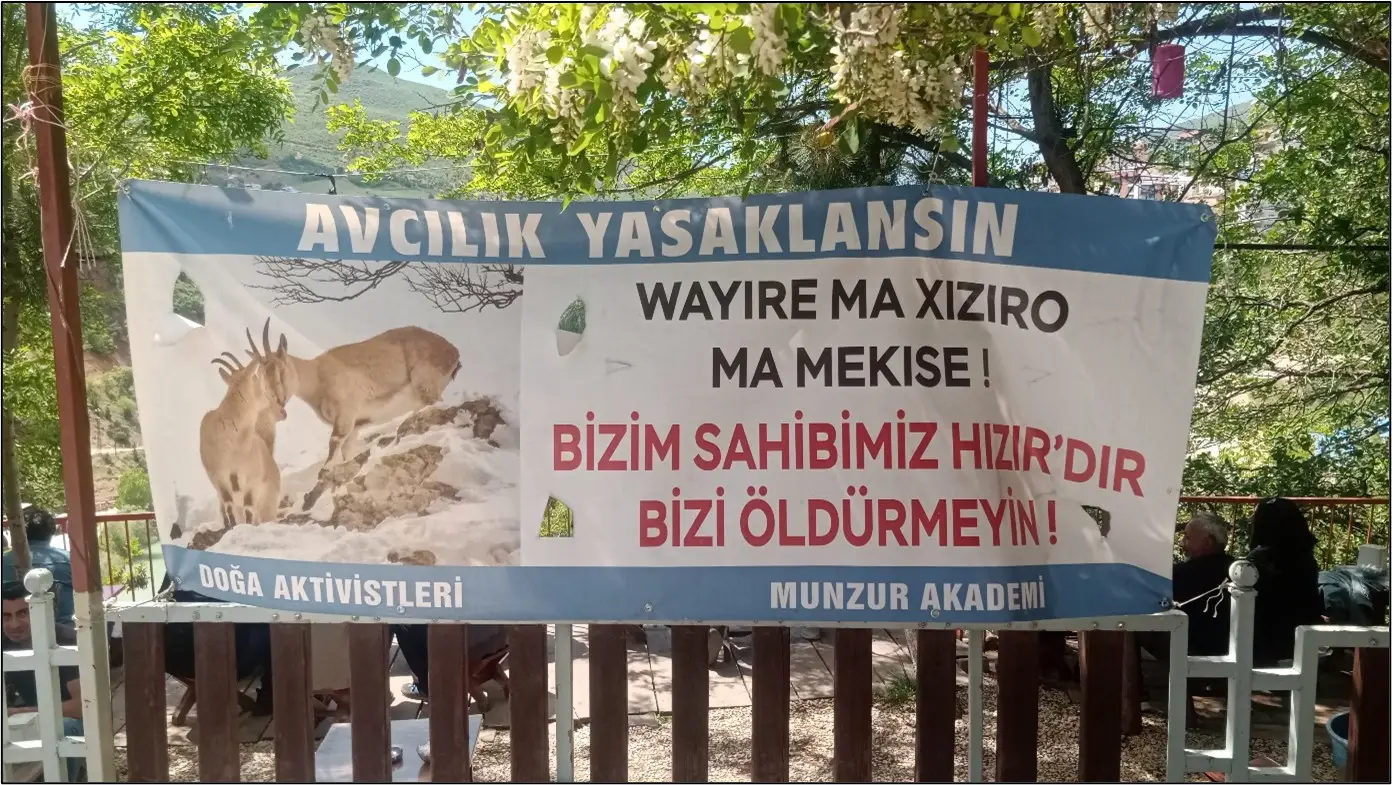
This activism contributed to a broader rediscovery of Alevi Kurdish oral traditions, initially led by local scholars and artists in the 1990s and later extending to the wider population, both locally and in the diaspora. Public demonstrations made it visible, notably in Seyit Rıza Square, a central site of resistance in Dersim, where groups such as Activists for Nature and the Munzur Academy displayed banners showing ibexes accompanied by messages in Turkish and Kirmanckî Kurdish: “Let hunting be banned. Our protector is Xızır-do not kill us.” Since the 2000s, ibexes-frequently seen along roads in winter and on mountain slopes in summer-have thus become a powerful and unifying symbol in a region long marked by state violence (İlengiz 2023). Today, many Alevi Kurdish activists in Dersim view these animals as “sacred” in reference to local Alevi traditions and see their protection as a political duty.
Conclusion
This entry analyses the position of ibexes (Capra aegagrus) in the Raa Haqi cosmology of Dersim as active non-human agents embedded in a moral and cosmological order that links humans, landscape, and invisible beings. Known as Xızır’s herd (malê Xizirî), ibexes are believed to move between the visible and hidden worlds, observe human behaviour, and mediate moral accountability through reward or punishment. The taboo surrounding their hunting did not function as an absolute ban but as an ethical boundary whose violation was understood to provoke cosmological consequences, including illness, death, natural disasters, or communal sanctions enacted in cem assemblies. Through narratives of dreams, avalanches, and divine intervention, ibexes emerge as mediators of justice and guardians of sacred geography, embodying the reciprocal relationship between ecological conduct and moral responsibility in Raa Haqi belief.
Since the late 1990s, these cosmological meanings have been reactivated within the context of ecological degradation, forced displacement, and state violence that have shaped modern Dersim. In this process, ibexes have become powerful symbols through which local religious knowledge, environmental ethics, cultural identity, and political activism converge. The ban on ibex hunting introduced in 2019 represents the institutional outcome of a long-term, multi-actor mobilisation rooted in local cosmology and reinforced by academic, legal, and artistic interventions. Xızır’s Sacred Herd thus illustrates how sacred geography in Raa Haqi not only structures everyday moral life but also provides symbolic legitimacy and ethical coherence to contemporary environmental struggles, highlighting the entanglement of nature, belief, and resistance in Dersim.
Gültekin, Ahmet Kerim. 2021. “Dersim as a Sacred Land: Contemporary Kurdish Alevi Ethno-Politics and Environmental Struggle.” İçinde Ecological Solidarity and the Kurdish Freedom Movement: Thought, Practice, Challenges, and Opportunities, editör Stephen E. Hunt, 225-243. Lanham, MD: Lexington Books.
Hanoğlu, Hayal, vd. 2025. “Resistance in a ‘Sacred Geography’: Critical Perspectives on Land, Ecology and Activism Among Dersimi Alevis in Turkey.” Geoforum 161. https://www.sciencedirect.com/science/article/pii/S0016718525000636
İlengiz, Çiçek. 2023. “Kutsal Olan ve Olmayan: İşte ‘bütün mesele’ bu mu?” İçinde Dağdaki Keçi, Gökteki Ay, Sudaki Balık, editör Rezzan Gümgüm. İstanbul. www.depoistanbul.net/wp-content/uploads/2023/04/ilengiz-tr.pdf
Lezgin, Rüstem. 2016. Ferhenge Kirmanckî (Zazakî)-Tirkî. Diyarbakır: Vate Yayınları.
Zarcone, Thierry. 2017. Le cerf. Une symbolique chrétienne et musulmane. Paris: Les Belles Lettres.