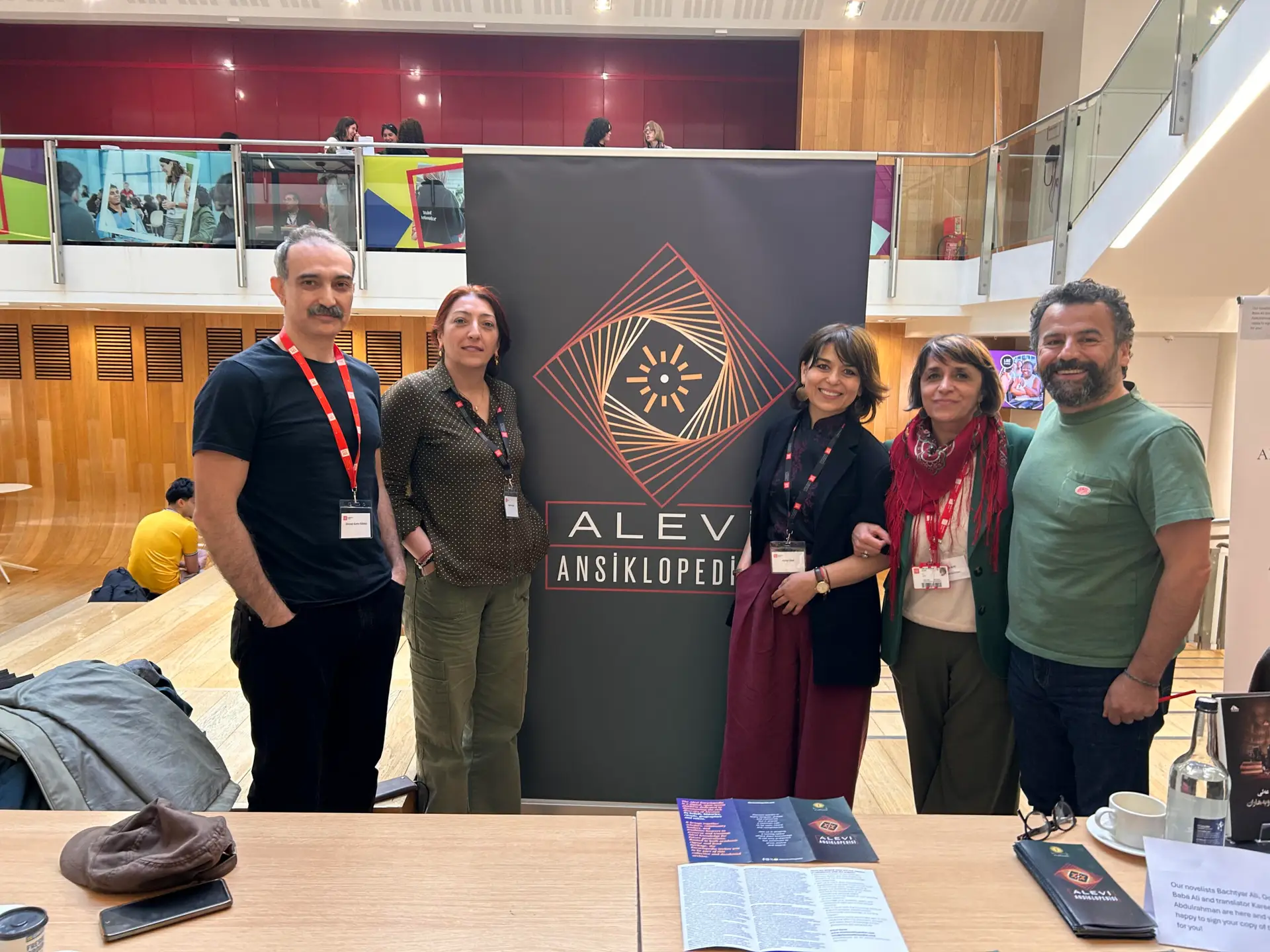
The Alevi Encyclopedia participated in the Kurdish Studies Conference, held at the London School of Economics from 29 April to 1 May 2026, where it met with an international academic audience. A dedicated information stand was opened for the Alevi Encyclopedia during the conference. In addition, the project was represented both institutionally and academically in a special panel that addressed the intersections between Alevi Studies and Kurdish Studies. The panel, titled “Alevi and Kurdish Studies at the Crossroads: Rethinking Fields and Research Horizons,” took place on Thursday, 30 April 2026, and was chaired by Dr Ümit Çetin. The panel featured presentations by Dr Hakan Mertcan, Dr Hayal Hanoğlu, Dr Ahmet Kerim Gültekin, and PhD candidate Ece Esmer Kırma.
The panel provided an important academic platform for discussing the mutual relations, shared experiences, overlapping research themes, and methodological questions connecting Alevi Studies and Kurdish Studies. Its general framework focused on the relationship between Alevi Studies, which has rapidly developed as an international field in recent years, and Kurdish Studies, a more established field that continues to reassess its own boundaries and conceptual frameworks. In this context, Kurdish Alevism/Raa Haqi, Arab Alevis, gender studies, sacred place practices, and collective knowledge production were discussed as key examples opening new possibilities for dialogue between the two fields.
In her presentation, “Collective Knowledge-Making in Alevi Studies: The Alevi Encyclopedia,” Dr Hayal Hanoğlu introduced the Alevi Encyclopedia as a new model of collective, multilingual, open-access, and academic knowledge production in the field of Alevi Studies. The presentation emphasised that the Alevi Encyclopedia is not merely a digital publication platform, but also an international knowledge network bringing together scholars, editors, members of the scientific advisory board, field researchers, and carriers of oral culture. The Encyclopedia’s contribution to making academic knowledge on Alevism accessible to wider publics, rendering different Alevi traditions visible, and enabling the multilingual circulation of Alevi knowledge was received with strong interest by conference participants.
Dr Ahmet Kerim Gültekin’s presentation, “Intersecting Fields: Kurdish Alevism (Raa Haqi) at the Crossroads of Alevi and Kurdish Studies,” examined Kurdish Alevism/Raa Haqi as one of the most significant points of intersection between Alevi Studies and Kurdish Studies. The presentation approached Dersim not merely as an ethnic, religious, or regional identity question, but as a distinctive field that needs to be reconsidered through local epistemologies, including Raa Haqi cosmology, sacred geography, jiare practices, Ocak–talip relations, oral culture, memory, and non-human agency. In this way, Dersim and Kurdish Alevism were presented not as a simple “problem of classification” between two disciplinary fields, but as a productive analytical ground for reassessing the established concepts, methods, and boundaries of both Alevi Studies and Kurdish Studies.
The other contributions to the panel expanded this intersectional field from different angles. Dr Hakan Mertcan’s presentation on Arab Alevis opened up a discussion on the regional, linguistic, and historical diversity of Alevism within the context of Kurdish Studies. Ece Esmer Kırma’s ecofeminist approach to jiara and human–more-than-human relations established a strong connection with emerging theoretical orientations in Alevi and Kurdish Studies concerning ecology, sacred place, embodied practices, and more-than-human worlds. As a result, the panel discussed Alevism not only through the lenses of identity, migration, or political recognition, but also in relation to ecology, material religion, locality, memory, gender, and alternative epistemologies.
The Alevi Encyclopedia stand opened during the conference enabled these academic discussions to reach a broader field of interaction. Through the stand, the structure, publication policy, multilingual content, scientific advisory board, editorial process, and future goals of the Alevi Encyclopedia were introduced to conference participants. Members of the editorial board and scientific advisory board met with scholars from different countries and held productive exchanges on possible collaborations, joint publications, panel proposals, and cross-field research networks. This process showed that the Alevi Encyclopedia resonates not only within Alevi Studies, but also across Kurdish Studies, diaspora studies, anthropology of religion, memory studies, oral history, and digital humanities.
One of the notable sessions of the conference was the roundtable on the emerging Encyclopaedia of the Kurds initiative. Listed in the programme under the title “Launching the Encyclopaedia of the Kurds: Vision, Structure, and Scholarly Contribution,” this session opened a discussion on a similar encyclopedic knowledge infrastructure within the field of Kurdish Studies. The indirect dialogue between this session and the presence of the Alevi Encyclopedia at the conference showed that digital encyclopedias are not simply tools for compiling information, but also new institutional models for epistemic justice, collective memory, academic standardisation, and community engagement. This encounter also made the methodological, editorial, and community-oriented distinctiveness of the Alevi Encyclopedia more visible.
The presence of the Alevi Encyclopedia at the LSE Kurdish Studies Conference became a concrete and productive example of the developing academic dialogue between Alevi Studies and Kurdish Studies. The conference demonstrated that Alevism, and especially Kurdish Alevism/Raa Haqi, is not merely a subfield or marginal research topic, but a central area of discussion that enables both fields to rethink their theoretical, methodological, and epistemological boundaries. In this context, the Alevi Encyclopedia played an important role as an open-access and collective knowledge platform that brings Alevi knowledge into international academic circulation and connects different disciplines and generations of researchers.
This encounter at LSE strengthened the Alevi Encyclopedia’s relations with international academic networks and offered a broader perspective on the future of Alevi Studies: comparative, interdisciplinary, multilingual, decolonial, and developed in active engagement with communities. In this respect, the conference was not only a platform for introducing the Alevi Encyclopedia, but also an important academic encounter that made visible new research horizons through which Alevi Studies can think together with Kurdish Studies and related fields.