Adır / Agır (Fire)
Fire in the Raa Haqi Tradition [1]
In the Raa Haqi tradition, fire is regarded as one of the sacred trusts granted to humanity by Haq. It is believed that this trust reached human beings through Ali. The association of lightning with Ali’s Zülfikar gives fire both cosmological and moral significance. Within this context, curse expressions such as “Kıla Eli” or “Toraniso” carry the idea of being consumed by Ali’s flame or fire (Gezik and Çakmak 2010).
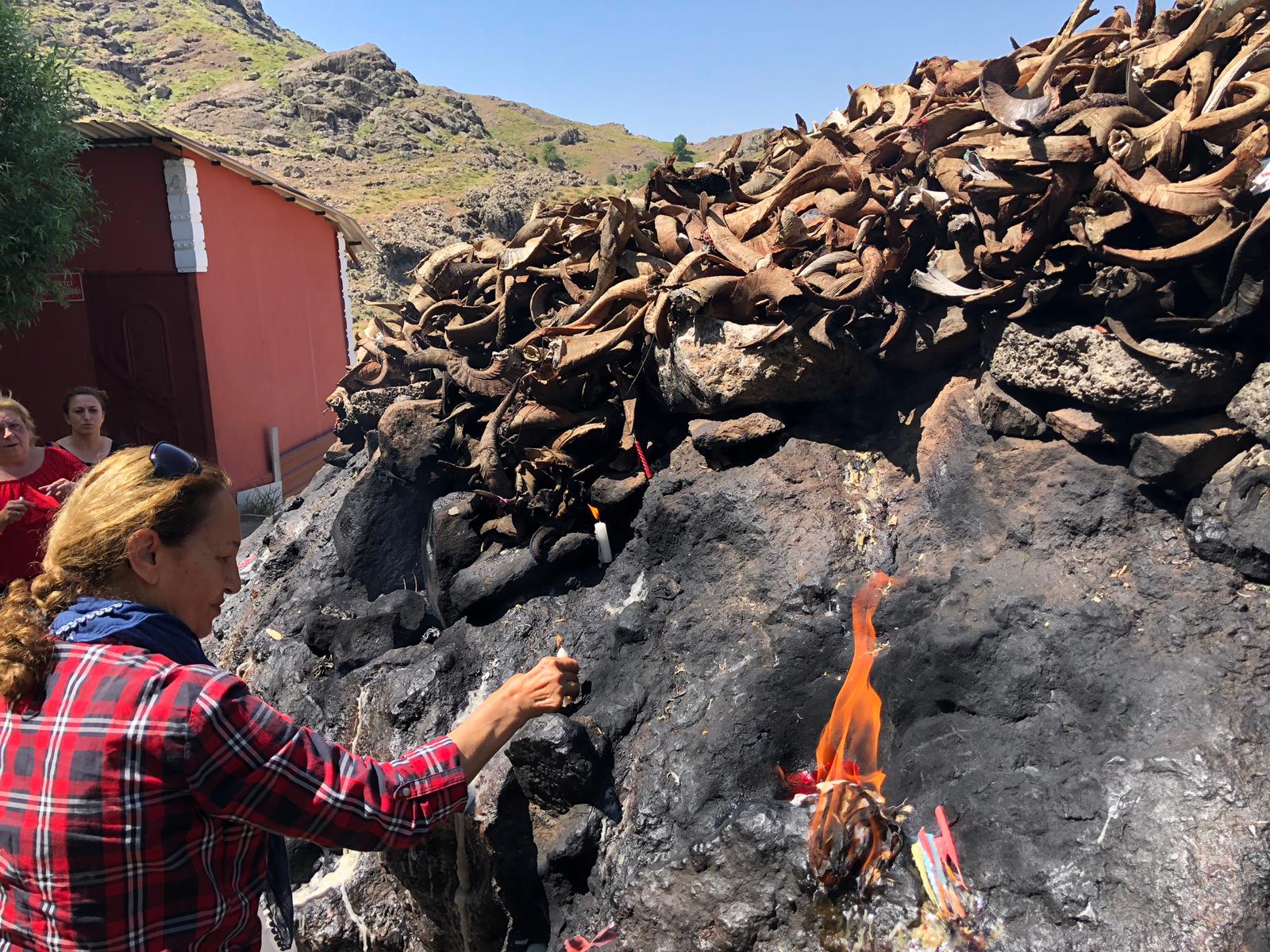
Everyday beliefs and practices concerning fire are likewise rooted in this understanding of sacredness. Not extinguishing a fire unnecessarily, refraining from throwing impurities into it, telling bad dreams to the fire, and behaving respectfully in its presence are among the most common examples. Fire is therefore understood not merely as a physical element but as a force that hears, carries, purifies, and transforms.
Fire in Ritual and Miracle Narratives
Fire also occupies an important place in the miracle narratives of dervishes. In some accounts, dervishes demonstrate their sacred power and miraculous abilities by entering fire during a cem. In ceremonies performed for the deceased, pieces of oily dough are thrown into the fire while prayers are recited. This practice is associated with the purifying, mediating, and sacred functions attributed to fire (Gezik and Çakmak 2010).
Melek-i Tavus and the Symbolism of the Nefs
Fire is one of the elements from which Melek-i Tavus was created. For this reason, it is associated not only with a sacred trust but also with an inner force that must be tested and controlled. The fact that Melek-i Tavus was created from fire is presented as one of the reasons why he refused to prostrate himself before Adam. In this context, fire becomes a symbol of the nefs-an inner power that, when left uncontrolled, may lead to pride, rebellion, and wrongdoing (Gezik 2022, 363-88; Gezik and Çakmak 2010).
Conclusion
In the Raa Haqi tradition, adır/agır carries a dual meaning as both a sacred trust and a testing force. It is regarded as a sacred power through its association with Ali, Zülfikar, lightning, and miracle narratives, while in relation to Melek-i Tavus and the nefs it represents the inner trials of the human being. Fire is therefore understood within Raa Haqi cosmology as a domain that is at once protective and dangerous, purifying and testing.
Gezik, Erdal. 2022. “‘Let Me Tell You How it All Began’-A Creation Story Told by Nesimi Kılagöz from Dersim.” Oral Tradition 35 (2): 363-388.
Gezik, Erdal, and Hüseyin Çakmak. 2010. Raa Haqi – Riya Haqi / Dersim Aleviliği İnanç Terimleri Sözlüğü. Ankara: Kalan Yayınları.
Gezik, Erdal. 2009. “Nesimi Kılagöz ile Yaratılış Üzerine.” Munzur Etnografya Dergisi 32: 4-34.
Bir sonraki adımda bunun Almanca çevirisine geçebiliriz.
License information
© The Author(s). Unless otherwise stated, entries published in the Alevi Encyclopedia are licensed under a Creative Commons Attribution 4.0 International License.