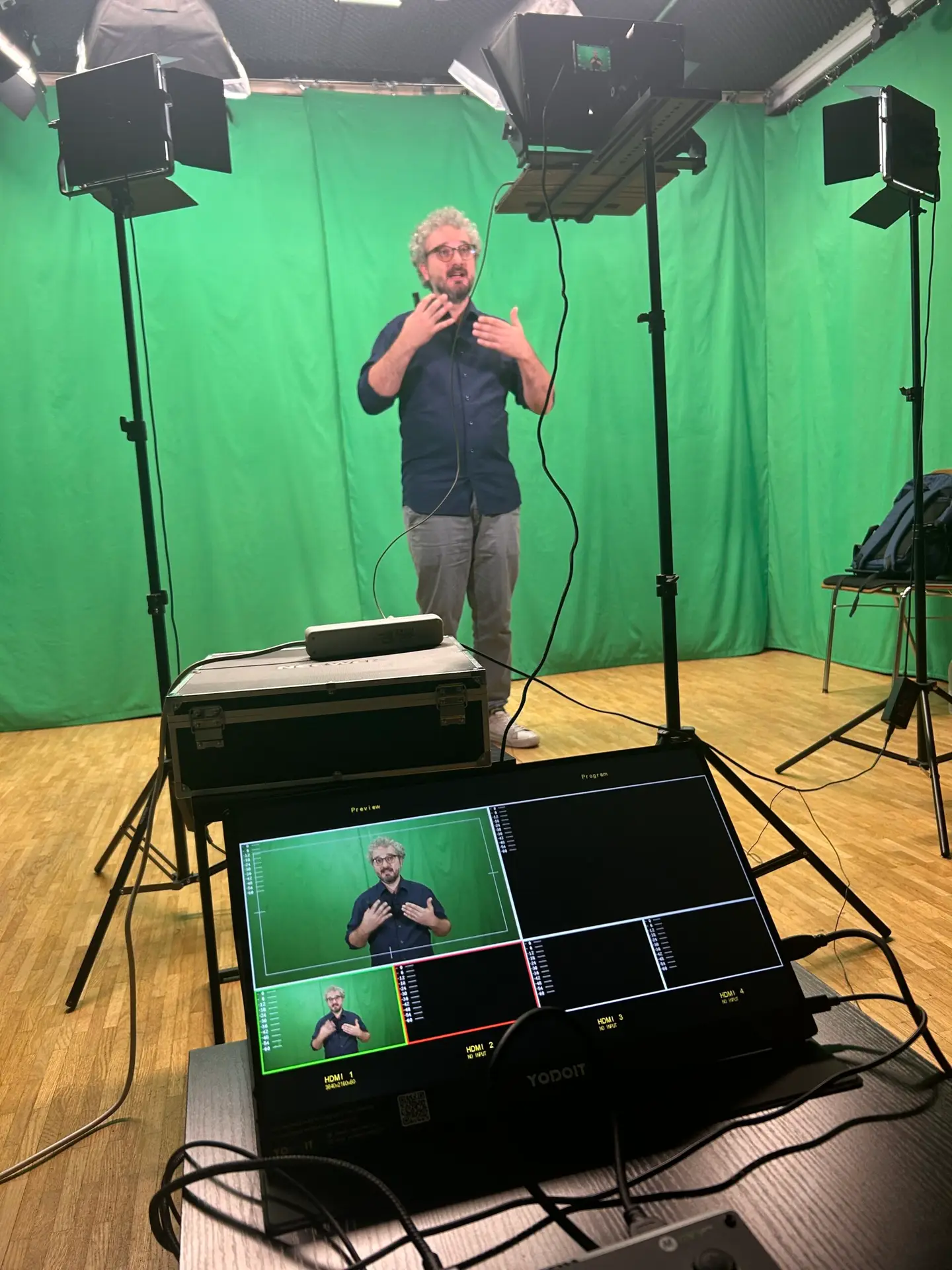
The first recordings of the video lecture series Alevi Encyclopedia Open Lecture Series: Key Topics, Concepts and Contemporary Debates in Alevi Studies, developed as the third main publication line of the Alevi Encyclopedia, have been completed in Berlin.
The recordings took place on 11 and 18 July 2026 at Alevitische Gemeinde Berlin e.V. / Berlin Cemevi, in the CanoCan Films studio. The technical production and studio process were carried out by producer Ekin Can Erol.
An open-access academic lecture platform for Alevi Studies
The Alevi Encyclopedia Open Lecture Series was prepared to make academic knowledge produced in the field of Alevi Studies more accessible to university students, researchers, educators and the broader public.
In recent years, Alevism has become an increasingly important international field of research across disciplines such as history, anthropology, sociology, religious studies, theology, political science, migration studies and cultural studies. However, academic knowledge in this field is often dispersed across different languages, disciplines and publication platforms.
The Open Lecture Series aims to bring this dispersed knowledge together around key concepts, historical contexts and current debates. The lectures are designed especially as academic teaching materials for undergraduate, graduate and doctoral students. At the same time, the series also addresses a wider audience seeking reliable and accessible knowledge about Alevism.
First lectures to be published in October 2026
The first recordings brought together leading scholars in the field of Alevi Studies. The lectures were prepared in a short video format of approximately 15–20 minutes. After post-production, editing, visual design and subtitling, the first lectures are planned to be published on the Alevi Encyclopedia website from October 2026 onwards.
The lectures are initially being prepared mainly in English and German. They will later be supported with subtitles and written materials in Turkish and other languages. In this way, the series will become not only watchable, but also readable, citable and directly usable in university teaching.
Two intensive recording days in Berlin
The first recordings were completed over two separate filming days. On 11 July 2026, the lectures of Dr Samuel Vock-Verley, Dr Ümit Çetin, Dr Celia Jenkins, Dr Besim Can Zırh, Dr Zeynep Türkyılmaz and Prof. Dr Markus Dreßler were recorded.
On 18 July 2026, the lectures of Dr Mark Soileau, Deniz Ali Gür, Prof. Dr Cem Kara, Dr Hayal Hanoğlu and Dr Ahmet Kerim Gültekin were recorded.
The series covers key topics such as Dersim/Raa Haqi, Alevi theology, Hızır/Xızır, Alevi migration experiences, the reconstruction of Alevism in the European diaspora, Alevi women, Bektashism, Hacı Bektaş Veli, Dersim 1937/38, epistemic and physical violence, oral tradition and textuality.
Markus Dreßler and Cem Kara among the contributors
The first term of the series also includes important scholars in the field of Alevi Studies. Prof. Dr Markus Dreßler is Professor of Modern Turkish Studies at the Institute for the Study of Religions at Leipzig University. His work focuses on religion, secularity, Alevism, and the relationship between religion and politics in late Ottoman and Republican Turkey.
Prof. Dr Cem Kara is Professor of Alevi Theology at the Institute of Alevi Theology in the Department of Religions at the University of Hamburg. His research focuses on Alevi theology, oral tradition, textuality, Bektashism and Alevi historiography.
During the recordings in Berlin, Prof. Dr Markus Dreßler and Prof. Dr Cem Kara came together with scholars from different countries, the Alevi Encyclopedia team and the CanoCan Films production team.
The third publication line of the Alevi Encyclopedia
The Alevi Encyclopedia has so far developed through three main publication areas: encyclopedia entries, the “Yol Önderlerinin Dilinden” video archive, and now the Alevi Encyclopedia Open Lecture Series.
The encyclopedia entries offer short, referenced and accessible texts on Alevi history, theology, rituals, institutions, diaspora experiences, gender, memory, music and sacred places. The “Yol Önderlerinin Dilinden” video archive records the oral memory of pirs, anas, dedes, babas, seyits, zakirs and other Alevi knowledge holders.
The Open Lecture Series transforms academic knowledge into a systematic, teachable and long-term archivable video education platform. In this respect, the series is considered a new step in strengthening the digital knowledge infrastructure of the Alevi Encyclopedia.
Collaboration between the Alevi Studies Network and the Alevi Encyclopedia
The Open Lecture Series was developed through academic collaboration between the Alevi Encyclopedia and the Alevi Studies Network. The academic coordination of the project is led by Dr Ahmet Kerim Gültekin, while Dr Ümit Çetin, Dr Besim Can Zırh, Dr Berfin Emre, Dr Celia Jenkins and Dr Hayal Hanoğlu contributed to the scientific advisory process.
The Alevi Studies Network is an international academic communication network that brings together around 500 researchers working on Alevism. The Alevi Encyclopedia is a multilingual digital knowledge platform publishing in Turkish, English and German, and is officially registered within international library and archive infrastructures with the ISIL code DE-4607.
Aim: Carrying Alevi knowledge to future generations
The Alevi Encyclopedia Open Lecture Series was developed to ensure that knowledge about Alevism does not remain confined to academic publications, but becomes accessible to students, younger generations, Alevi communities and the wider public.
The series aims to respond to the need for reliable, scholarly and multilingual knowledge about Alevism. It is also seen as an important step in preserving Alevi cultural heritage, oral memory and academic knowledge in the digital age and transmitting them to future generations.
The Alevi Encyclopedia team aims to expand the Open Lecture Series in the coming years with new terms, additional languages and further teaching materials, and to turn it into a permanent open-access educational resource for university teaching.