Kemeré Duzgı / Düzgün Baba
Dersim, Raa Haqi, and the Context of Sacred Geography
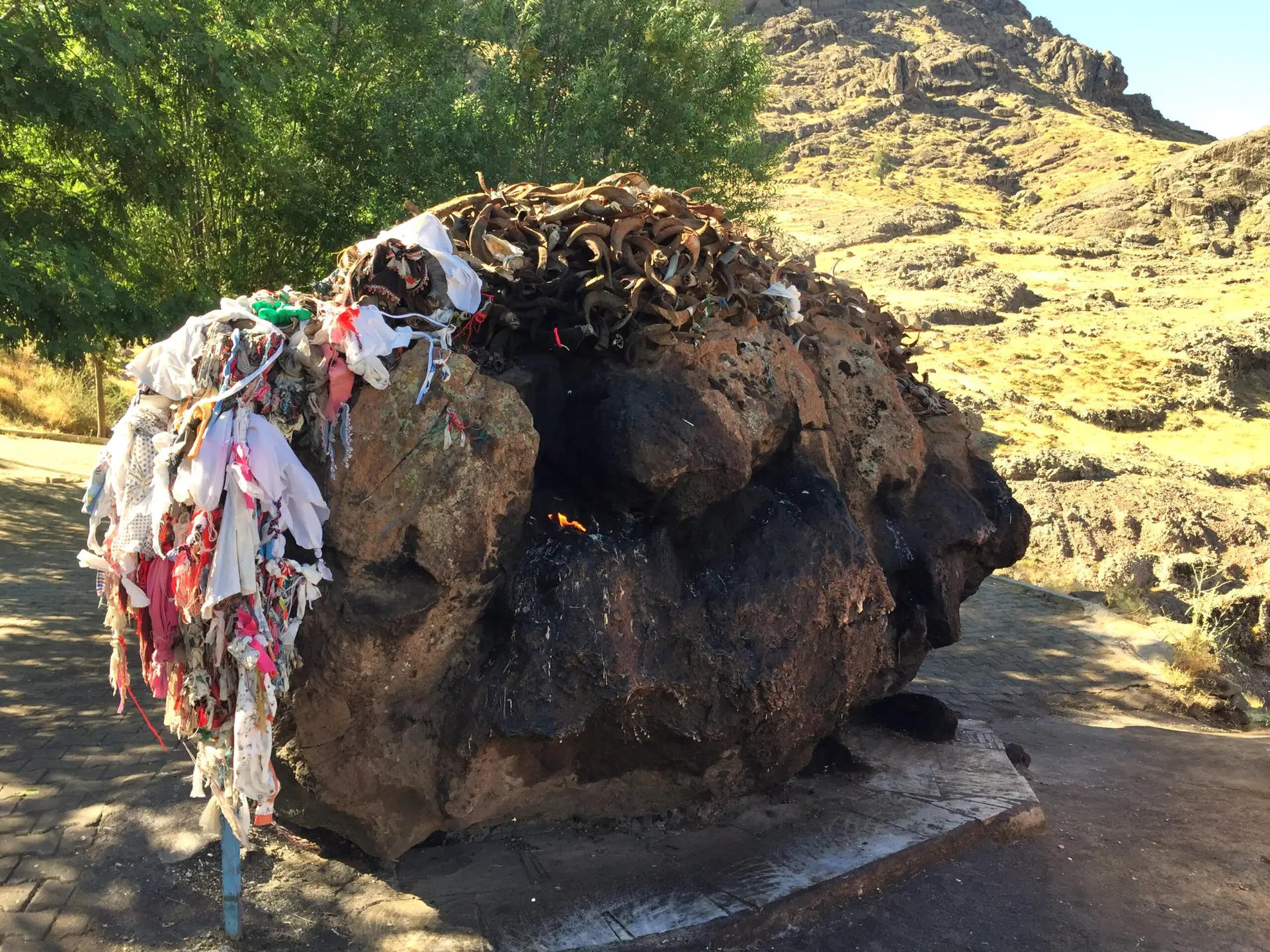
Kemeré Duzgı, now commonly known as Düzgün Baba, is one of the principal sacred beings and pilgrimage sites of Raa Haqi, located in eastern Dersim, in the Nazımiye district of present-day Tunceli province. Understanding Duzgı’s place within this religious world first requires consideration of the meanings attributed to Dersim. In Raa Haqi cosmology, Dersim is a sacred geography that extends beyond historically shifting administrative boundaries, where humans, ancestors, and non-human sacred beings live together. Local designations such as Jiar-u Diyar (the land of sacred beings/places) and Herd-u Dewreş (the land of dervishes) express this connection between the land, social belonging, and religious life (Gültekin 2020; 2022; 2026, 179-183).
Accounts of Dersim produced by outsiders have often explained this world of meaning through different categories. Western travellers and missionaries emphasised images of a ‘mysterious’, ‘inaccessible’, or ‘undiscovered’ landscape, while late Ottoman and early Republican reports portrayed the region as a territory inhabited by tribes that needed to be controlled and transformed. Reading these accounts, shaped by differing political and religious expectations, alongside the community’s own concepts and experiences is important for understanding Dersim’s cultural reality (Gültekin 2025; 2026, 177-180).
In Raa Haqi, reality takes shape through two interpenetrating dimensions, Zahir and Batın. Zahir is the visible world in which humans live their everyday lives alongside other beings. Batın is the dimension inhabited by ancestors, persons who have become sır, and various non-human sacred beings, with whom contact can be established through rituals, dreams, and experiences of miracles. This distinction does not imply two isolated universes. Mountains, waters, caves, rocks, trees, sacred objects, and ancestral graves participate in everyday life as jiares in which these dimensions intersect (Gültekin 2026, 180-182).
Sacred geography, understood in this way, is a world constituted jointly by the social relations of ocak and talip tribes and the mythological patterns through which the kinship, powers, and reciprocal obligations of jiares are narrated. Within these relationships, Duzgı emerges as a personified being who is consulted, whose protection is trusted, and whose actions are interpreted as meaningful. His existence, identified with the mountain, demonstrates how geography and social life constitute one another in Raa Haqi (Gültekin 2020; 2022; 2025).
Duzgı as a Jiare and Wayır
Within the religious world of Raa Haqi, jiare encompasses a sacred place, the non-human being dwelling there, and various sacred objects. Mountains, water sources, and ancestral graves, as well as objects kept in particular households as sacred heirlooms, may therefore be regarded as jiares. Each jiare has its own personality, narrative, relationships with other beings, and expectations of human behaviour. Some are known for their protective or healing powers, while others are believed capable of harming humans. Relations with jiares are thus shaped by reciprocal obligations that take account of their distinctive powers and characteristics (Gültekin 2020; 2022; 2026, 181-182; see also Feber 1992, 22-24; Gezik 2000, 15-28; Deniz 2012; 2015, 63-82).
Among these sacred beings, Duzgı stands out through his status as a wayır (owner). This status signifies his superior mystical power, authority over other jiares, and protective role. In mythological narratives, Duzgı is the warrior leader of the jiares defending Dersim against malevolent forces. His presence, associated with the mountain, rocks, wild goats, and the eagle, makes this protection visible in everyday life. For those who turn to him, Duzgı is a powerful interlocutor whose assistance can be sought, from whom justice is expected, and with whom troubles can be shared (Gültekin 2020; 2026, 183-184; see also Feber 1992, 22-24; Gezik 2000, 15-28; Deniz 2012; 2015, 63-82).
The religious authority of jiares can be understood through these everyday relationships with humans. Unlike the periodic visits undertaken by pirs in the past, talips’ encounters with jiares could be shaped by everyday needs. Lighting çıra, offering niyaz, pledging an animal sacrifice, or sleeping at a sacred place to experience dreams are among the practices through which individuals seek answers to their problems. The meanings drawn from these experiences may influence personal decisions and moral attitudes. Duzgı’s guidance belongs to this religious sphere, in which talips can interpret their own experiences (Gültekin 2020; 2022; 2026, 182; see also Feber 1992, 22-24; Gezik 2000, 15-28; Deniz 2012; 2015, 63-82).
In this context, talip-centred religiosity refers to an individual’s ability to worship without necessarily requiring mediation by ocak members in their relationship with the sacred. Individual experience takes shape within the knowledge and ritual repertoire inherited through oral culture, while also allowing room for personal interpretation. The authority of ocaks, grounded in descent and ikrar, and the directly experienced power of jiares thus constitute two interconnected but not entirely overlapping spheres of religious authority. Duzgı’s relationship with ocaks should likewise be understood in terms of this interconnectedness, relative autonomy, and occasionally heightened tension (Gültekin 2020; 2022).
The Narrative of Duzgı and Kurês: Hidden Tension
One widely shared narrative describes Duzgı as the young, unmarried son of Kurês, the mythological ancestor of the Kureyşan Ocak. Living apart from village society and tending his father’s goat herd on the mountain, Duzgı feeds his animals through the harsh winter by making the ground and plants turn green wherever he touches them with his staff. Curious about the herd’s well-being, Kurês secretly watches his son and witnesses miracles that surpass his own powers. Realising that his father has seen him, Duzgı feels ashamed, withdraws to the higher reaches of the mountain, and becomes sır. The narrative thus explains his passage from Zahir to Batın and his immortal existence, identified with the mountain (Gültekin 2020; 2026, 183-184; see also Feber 1992, 22-24; Gezik 2000, 15-28; Deniz 2012; 2015, 63-82).
This narrative can also be read as a mythological expression of the relationship between two spheres of religious authority in Raa Haqi. Kurês represents village society organised through descent, ocak authority, and the continuity of the social order. Duzgı, meanwhile, is associated with the mountain, wildlife, nomadism, and individual religious experience. Whereas Kurês’s power becomes apparent in the regulation of social relations and dealings with other ocaks, Duzgı’s miraculous acts directly regenerate the life that sustains the herd. This distinction points to different sources of sacred knowledge and legitimacy (Gültekin 2020; 2022; 2025; see also Feber 1992, 22-24; Gezik 2000, 15-28; Deniz 2012; 2015, 63-82).
Within this framework, Duzgı’s ‘flight’ can be interpreted as relinquishing the assertion of his superiority over his father and leaving the order of Zahir to him. Duzgı does not enter into an explicit contest of miracles with Kurês; by withdrawing into Batın, he sustains his power in another sphere of existence. This suggests an accommodation marked by tension, which preserves social cohesion while maintaining the distinction between sources of authority. The notion of ‘hidden tension’ is an analytical interpretation developed to explain this aspect of the narrative (Gültekin 2020; 2022; 2025; see also Feber 1992, 22-24; Gezik 2000, 15-28; Deniz 2012; 2015, 63-82).
The social expression of this accommodation can be seen in the ability of talips to turn to different religious authorities. Where the decisions of pirs are contested, or competing authorities offer contradictory advice, dreams and signs experienced at jiares may provide alternative guidance. At the same time, incorporating Duzgı into the genealogical narrative as the son of Kurês connects his power to the prestige of the Kureyşan Ocak. The same narrative thus establishes a bond between ocak and jiare while preserving Duzgı’s autonomous position, which is not wholly subordinate to that bond (Gültekin 2020; 2022).
Pilgrimage, the Path, and Embodied Spiritual Experience
Pilgrimage to Kemeré Duzgı is a process of worship in which the idea of walking the path in Raa Haqi is experienced through bodily, emotional, and spiritual dimensions. Leaving home, approaching the mountain, ascending through sacred stopping places, and returning constitute complementary stages of this journey. As visitors follow the mountain’s paths, they move away from everyday life and enter a space in which they can reassess their conduct, relationships, and responsibilities in Duzgı’s presence (Gültekin 2020; 2026, 184-187; see also Feber 1992, 22-24; Gezik 2000, 15-28; Deniz 2012; 2015, 63-82).
In the past, large household groups belonging to Kurdish Alevi tribes travelled long distances to Duzgı on foot, sometimes bringing their herds and tents, and camped for days around particular jiares on the mountain. These visits, during which sacrificial offerings and niyaz were shared, also enabled people from different settlements to exchange news, discuss community matters, and make collective decisions. Personal worship thus took place within an intense social interaction that brought households together (Gültekin 2020; 2022; 2026, 184; see also Feber 1992, 22-24; Gezik 2000, 15-28; Deniz 2012; 2015, 63-82).
Within this journey, çile connects bodily hardship with self-questioning. Walking barefoot, becoming tired and thirsty, and negotiating difficult rocky terrain acquire meaning as ways of sharing Duzgı’s çile, associated with his withdrawal into the mountain and his becoming sır. In this respect, climbing the mountain is an act of worship through which visitors confront their past actions and subject themselves to moral self-examination, expressed as dara çekilmek. Physical ascent also carries a symbolic dimension, signifying distance from everyday authorities and a closer relationship with Batın (Gültekin 2020; 2022; 2025).
Caves, rocky passages, and water sources along the route shape the different stages of this experience. At some stopping places, visitors pray; at others, they wait silently, listen to accounts of miracles, or sleep in the hope of experiencing dreams. These practices are shaped by the characteristics of the jiare visited and the ritual knowledge inherited through oral culture, while also varying according to personal intentions, needs, and experiences. The scent of çıra, the texture of rocks, the coolness of water, and the sharing of offerings allow the sacred to be felt bodily. Since the entire mountain is identified with Duzgı, these sensory contacts are experienced as encounters with his presence (Gültekin 2020; 2022; 2026, 182, 185-187).
The emotional intensity of this encounter is particularly evident when some older women leave their groups to offer improvised, lament-like prayers in secluded places. These supplications often begin with the community’s past suffering, move through the experiences of ancestors and family members, and finally turn to the individual’s own troubles and expectations. The shared past is thus articulated anew within a personal life story. Addressing Duzgı becomes a form of personal reflection through which visitors can make sense of their experiences and reconsider decisions concerning the lives they will resume upon returning from the mountain (Gültekin 2020; 2022; 2025).
Jiares, Water, and Female Sacredness on Duzgı Mountain
Although Duzgı Mountain is regarded as a jiare in its entirety, it also encompasses caves, rocks, water sources, and passages associated with different sacred beings and narratives. Each of these stopping places is visited through its own particular rituals. The pilgrimage route thus forms a network of relationships connecting traces attributed to Duzgı’s life with the places of other sacred beings (Gültekin 2020; 2026, 185-187).
In Raa Haqi cosmology, mountains and rocks are associated with permanence, while water symbolises fluidity, renewal, abundance, and healing. Water’s association with cleanliness and innocence also gives certain springs a role in moral trials. One example is the small spring inside the cave identified with Duzgı’s sister, Xaskar. If the flow stops while a visitor is attempting to drink, this is interpreted as an adverse sign concerning that person’s moral standing. Contact with water thus becomes an experience through which individuals confront their own conduct (Gültekin 2020; 2022; 2026, 185-186; see also Feber 1992, 22-24; Gezik 2000, 15-28; Deniz 2012; 2015, 63-82).
Xaskar is among the female jiares to whom women visitors particularly turn. Principal practices in the cave include drinking water, applying it to the body, taking it away for healing, lighting çıra, and resting in the hope of experiencing dreams. The relationships women establish here with other women and female sacred beings create a relatively private religious space in which they can share personal troubles and expectations. Powers associated with healing and fertility are not, however, confined to female beings; Duzgı is also believed to assist women who wish to have children (Gültekin 2020; 2022; 2026, 186-187).
This diversity demonstrates how the genders, personalities, and attributed capacities of sacred beings shape rituals. Duzgı’s identity as a warrior and protector and Xaskar’s presence, associated with water and healing, enable different experiences within the same sacred geography. As pilgrims worship according to their own needs, they attend to the distinctive qualities of the jiares and the conduct required in their relationships with them.
Social Transformation: Cemevis, New Rituals, and the Temple Economy
Since the 1990s, as Dersimli/Kurdish Alevi identity has gained greater public visibility, Duzgı Mountain has become a focus of religious and political interest extending from local to international contexts. Expanding pilgrimage movements, bringing visitors from Turkey’s metropolitan centres and Europe, have also transformed the mountain’s spatial organisation. The cemevis opened on the Kıl village side in 2003 and the Nazımiye side in 2005, together with access roads and facilities serving visitors’ needs, are prominent examples of this transformation (Gültekin 2020; 2022).
Through organising accommodation, meals, and sacrificial services, cemevis have established new institutional structures that influence the management and representation of the sacred site. This process has involved negotiations over authority, services, and the distribution of resources among households belonging to the Kureyşan Ocak, talip groups, bekçis (wardens), and cemevi administrations. Relations on the mountain are thus shaped by claims to religious prestige and managerial authority among actors who are themselves internally differentiated (Gültekin 2020; 2025; 2026, 184).
Attempts to regulate pilgrimage occasionally create tensions with the personal forms of worship practised by talips. Visitors from different countries and social backgrounds bring new objects and practices to the mountain, interpreting inherited ritual knowledge through their own experiences. The growing prevalence of practices such as arranging stones into shapes, attaching small stones to rocks, and leaving photographs, written wishes, or pieces of cloth reflects this mobility. Although those providing services question some practices, talips continue to worship relatively independently at different places on the mountain. This situation can be interpreted as one expression of the historical tension over authority between ocaks and jiares under new institutional conditions (Gültekin 2020; 2022; 2025).
Increasing visitor movements have also expanded economic relationships centred on sacrificial offerings, niyaz, and çıralık. The distribution of offerings, organisation of services, and management of revenues are central features of what may be termed a ‘temple economy’. Questions concerning who may use the resources generated around Duzgı’s religious prestige, and under what authority, can fuel competition between households and institutions. Public controversies over interventions such as the construction of roads, stairways, statues, or facilities likewise reveal competing claims to rights and representation concerning the site’s future (Gültekin 2020; 2025; 2026, 184).
While ‘visitors’ comfort’ has emerged as an important justification in these debates, objections are also raised that construction weakens religious experiences grounded in çile, solitude, and direct contact with nature. Spatial changes therefore also alter the meaning of pilgrimage and the conditions of engagement with the sacred. Transformation at Duzgı can be understood as a process in which the continuity of Raa Haqi is renegotiated through the initiatives of talips and the interventions of different actors (Gültekin 2022; 2025).
Collective Memory, Diaspora, and Dersimli Identity
Kemeré Duzgı / Düzgün Baba is one of the principal symbolic focal points of Dersimli/Kurdish Alevi identity. Social memory, shaped particularly by the 1938 massacre, forced displacement, and the village evacuations of the 1990s, is transmitted through encounters, prayers, and narratives on the mountain. In this context, seeking Duzgı’s protection is connected with remembering the experiences of previous generations and making sense of present difficulties within a shared history (Gültekin 2022; 2025).
Oral culture sustains this memory by accommodating the experiences of each generation. Mythological narratives about Duzgı incorporate miracles believed to have occurred recently, personal encounters, and new social events. While their principal symbolic patterns endure, the narratives expand in content, allowing Duzgı’s guidance to be reinterpreted under changing conditions of life (Gültekin 2022; 2026, 183-184).
Pilgrimages undertaken by Dersimlis living in Turkey’s metropolitan centres and Western Europe are an important part of this transmission. Generations raised outside Dersim, in particular, connect the narratives heard within their families with the mountain’s tangible presence and reconstitute their sense of belonging through encounters with relatives and other visitors. Through these experiences, sacred geography brings people living in distant social settings together within a shared past and religious world (Gültekin 2022; 2025).
This connection also helps explain the religious and historical dimensions of resistance to interventions affecting nature in Dersim. Understanding mountains, waters, and forests in relation to jiares, ancestors, and the community’s past connects their protection with the continuity of collective existence. In this sense, Duzgı’s protective identity is a powerful reference point linking the preservation of sacred geography with contemporary Dersimli belonging (Gültekin 2022; 2026, 187-188).
Conclusion: Duzgı’s Place in Raa Haqi
Kemeré Duzgı / Düzgün Baba offers an important example of how sacred geography, religious authority, and social belonging constitute one another in Raa Haqi. His existence as a jiare and wayır enables talips to establish direct relationships with the sacred, question their own conduct, and make sense of the shared past through personal experience. The accommodation marked by tension in his relationship with Kurês reveals the interconnected yet relatively autonomous spheres of ocak authority and individual piety.
Pilgrimage to Duzgı, transformed through cemevis, diaspora mobility, and new ritual practices, also demonstrates how religious continuity is produced under changing conditions. The interpretations of talips, institutional interventions, and demands for the protection of the sacred site all contribute to this process. Duzgı thus continues to exist as an active sacred being who brings inherited faith and memory into contact with new experiences and participates in the reproduction of Dersimli/Kurdish Alevi belonging.
Aksoy, Gürdal. 2000. “Mithra’dan Bava Duzgın’a: Dersim’de Antik Dönem İnançlarının Sürekliliği Üzerine.” Munzur Etnografya Dergisi 2: 23-67.
Aksoy, Gürdal. 2006. Dersim Alevi Kürt Mitolojisi. İstanbul: Komal.
Comerd, Munzur. 1997. “Dersim İnancı’nda Duzgın.” Ware 11: 84-104.
Çakmak, Hüseyin. 2013. Dersim Aleviliği: Raa Haqi. Ankara: Kalan Yayınları.
Danık, Ertuğrul. 2006. Öteki Tanrılar: Alevi ve Bektaşi Mitolojisi. Ankara: İmge Kitabevi.
Deniz, Dilşa. 2012. Yol/Re: Dersim İnanç Sembolizmi-Antropolojik Bir Yaklaşım. İstanbul: İletişim Yayınları.
Deniz, Dilşa. 2015. “The Path: Dızgun Bawa, As an Example of Relation between Belief and Life Style.” Religious Inquiries 4 (8): 63-82.
Deniz, Dilşa. 2019. “Kurdish Alevi Belief System, Reya Heqi/Raa Haqi: Structure, Networking, Ritual and Function.” İçinde Kurdish Alevis and the Case of Dersim: Historical and Contemporary Insights, editörler Erdal Gezik ve Ahmet Kerim Gültekin, 45-75. Lanham, MD: Lexington Books.
Feber, Oda. 1992. “Düzgün Baba Ziyareti.” Berhem 1: 22-24.
Gezik, Erdal. 2000. “Munzur ve Düzgün’ün Sır Oluşlarının Tarihsel Bir Analizi.” Munzur Etnografya Dergisi 4: 15-28.
Gezik, Erdal, ve Hüseyin Çakmak. 2010. Raa Haqi-Riya Haqi: Dersim Aleviliği İnanç Terimleri Sözlüğü. Ankara: Kalan Yayınları.
Gezik, Erdal, ve Ahmet Kerim Gültekin, ed. 2019. Kurdish Alevis and the Case of Dersim: Historical and Contemporary Insights. Lanham, MD: Lexington Books.
Gültekin, Ahmet Kerim. 2004. Tunceli’de Kutsal Mekân Kültü. Ankara: Kalan Yayınları.
Gültekin, Ahmet Kerim. 2019. Kurdish Alevism: Creating New Ways of Practicing the Religion. Working Paper Series of the HCAS “Multiple Secularities-Beyond the West, Beyond Modernities” 18. Leipzig: Leipzig University.
Gültekin, Ahmet Kerim. 2020. Kutsal Mekânın Yeniden Üretimi: Kemeré Duzgı’dan Düzgün Baba’ya Dersim Aleviliğinde Müzakereler ve Kültür Örüntüleri. İstanbul: Bilim ve Gelecek Kitaplığı.
Gültekin, Ahmet Kerim. 2021. “Dersim as a Sacred Land: Contemporary Kurdish Alevi Ethno-Politics and Environmental Struggle.” İçinde Ecological Solidarity and the Kurdish Freedom Movement: Thought, Practice, Challenges, and Opportunities, editör Stephen E. Hunt, 225-243. Lanham, MD: Lexington Books.
Gültekin, Ahmet Kerim. 2024. “Kemerê Duzgi: The Protector of Dersim (Pilgrimage, Social Transformation, and Revitalization of the Raa Haqi Religion).” British Journal of Middle Eastern Studies 51 (3): 570-588. https://doi.org/10.1080/13530194.2022.2126350.
Gültekin, Ahmet Kerim. 2025. “Kemerê Duzgı’dan Düzgün Baba Kültüne: Raa Haqi (Dersim Aleviliği) Kozmolojisinde Jiareler (Ziyaretler) ve Sosyal Değişme.” İçinde Nazımiye: Tarih, Hafıza ve Alevi Kültürü Üzerine Kapsamlı Bir Derleme, editörler Şükrü Aslan, Zülfiye Koçak ve M. Ali Sağlam, 503-534. Ankara: Ütopya Yayınevi.
Gültekin, Ahmet Kerim. 2026. “High Altitude Sacred Places-Pastoral Myths and Immaterial Culture: An Ethnographic Perspective from the 20th Century in Dersim, Turkey.” İçinde Fernab und hoch droben: Neue Feldforschungen zu Heiligtümern in peripheren Lagen von der Antike bis in das Mittelalter, editörler Harald Stadler ve Michaela Konrad, 177-189. Ager Aguntinus: Historisch-archäologische Forschungen 9. Wiesbaden: Harrassowitz.
Yürür, Kızılca Gül. 2019. Dersim Alevileri’nde İyileştirme Geleneği. İstanbul: Otonom Yayıncılık.
License information
© The Author(s). Unless otherwise stated, entries published in the Alevi Encyclopedia are licensed under a Creative Commons Attribution 4.0 International License.