BLOG
The Institutionalization of Alevi Religious Education in Germany
The Emergence of the Agenda of Alevi Religious Education in Germany
The emergence of Alevi religious education in Germany is primarily connected to the religious and cultural problems that the children of migrant Alevi families encountered in their educational lives during the 1980s. In this period, a significant number of Alevi workers brought their families to Germany, and their children began attending German schools. Although parents were informed that they could, if they wished, send their children to Catholic or Protestant religion classes, children of Turkish origin were in many cases automatically directed to Turkish mother-tongue classes. However, the fact that some of the teachers in these classes provided Sunni-centred religious content was regarded as problematic by many Alevi parents.
The concerns of Alevi families were not limited to school lessons alone. From the 1970s onward, the strengthening of Sunni religious teaching in the mosques affiliated with the Islamic Cultural Centres, which became widespread especially in major cities and around the Ruhr region, as well as in the Qur’an courses that intensified during the 1980s, expanded the sphere of religious influence on Alevi children. It is also known that religion teachers and mosque personnel sent from Turkey to Germany after the 1980 military coup contributed to this process. In this environment, the fact that some Alevi schoolgirls were pressured by their Sunni classmates at school to wear headscarves was seen in Alevi circles as an influence contrary to Alevism in terms of the transmission of identity.
In addition, the effects of television, video cassettes, and the tools of popular culture that were widespread in the 1980s on children increased anxieties among Alevi families about cultural alienation. The fact that children were being influenced both by dominant religious practices and by a rapidly changing media environment made it clear that the transmission of Alevi identity through family and immediate social surroundings was no longer sufficient.
Broader political transformations also came to shape this process from the second half of the 1980s onward. The beginning dissolution of the Cold War balance, together with the identity questioning experienced by Alevi-origin leftist students, intellectuals, and trade unionists who came to Germany after the 1980 coup, created a new intellectual and organisational dynamism around Alevism. It thus became evident that Alevi organisation in Germany was not aimed solely at cultural solidarity, but was also seeking institutional solutions for the transmission of Alevi teaching to new generations. The demand for Alevi religious education in Germany took shape within this historical context.
The First Initiatives: The Case of Hamburg
The first concrete initiatives concerning Alevi religious education in Germany emerged in Hamburg. In its “Alevi Declaration,” published in May 1989, the Hamburg Alevi Cultural Group, founded at the end of 1988, drew attention to the existence of hundreds of thousands of Alevis living in Germany and emphasised the necessity of transmitting Alevi teaching to the second generation. This text marks one of the most important early steps indicating that the Alevi presence in Germany was beginning to be defined not only in the context of migration, but also in terms of religious and cultural continuity.
The Alevi Culture Week organised by the Hamburg Alevi Cultural Group between 2 and 7 October 1989, attended by approximately 5,000 people, constituted an important threshold in terms of public visibility. Following the strong interest shown in the event, preparations for institutional organisation in Hamburg accelerated, and on 9 June 1990 the “Hamburg Alevi Cultural Centre” was established in the building of the University of Hamburg. This institution is significant in that it was one of the first official structures established in Germany under the name Alevi.
The fact that the statutes of the Hamburg Alevi Cultural Centre explicitly included the teaching of Alevi culture classes in schools as an objective shows that the issue of Alevi religious education was considered part of the institutional agenda from the very beginning. The statutes envisaged meeting needs related to Alevi morality, teaching, and practice, and carrying out studies, research, and investigations to promote Alevi belief and culture within the framework of freedom of religion and belief. This approach demonstrates that, in subsequent years, the demand for the right to religious education was formulated not only pedagogically, but also on the basis of freedom of belief.
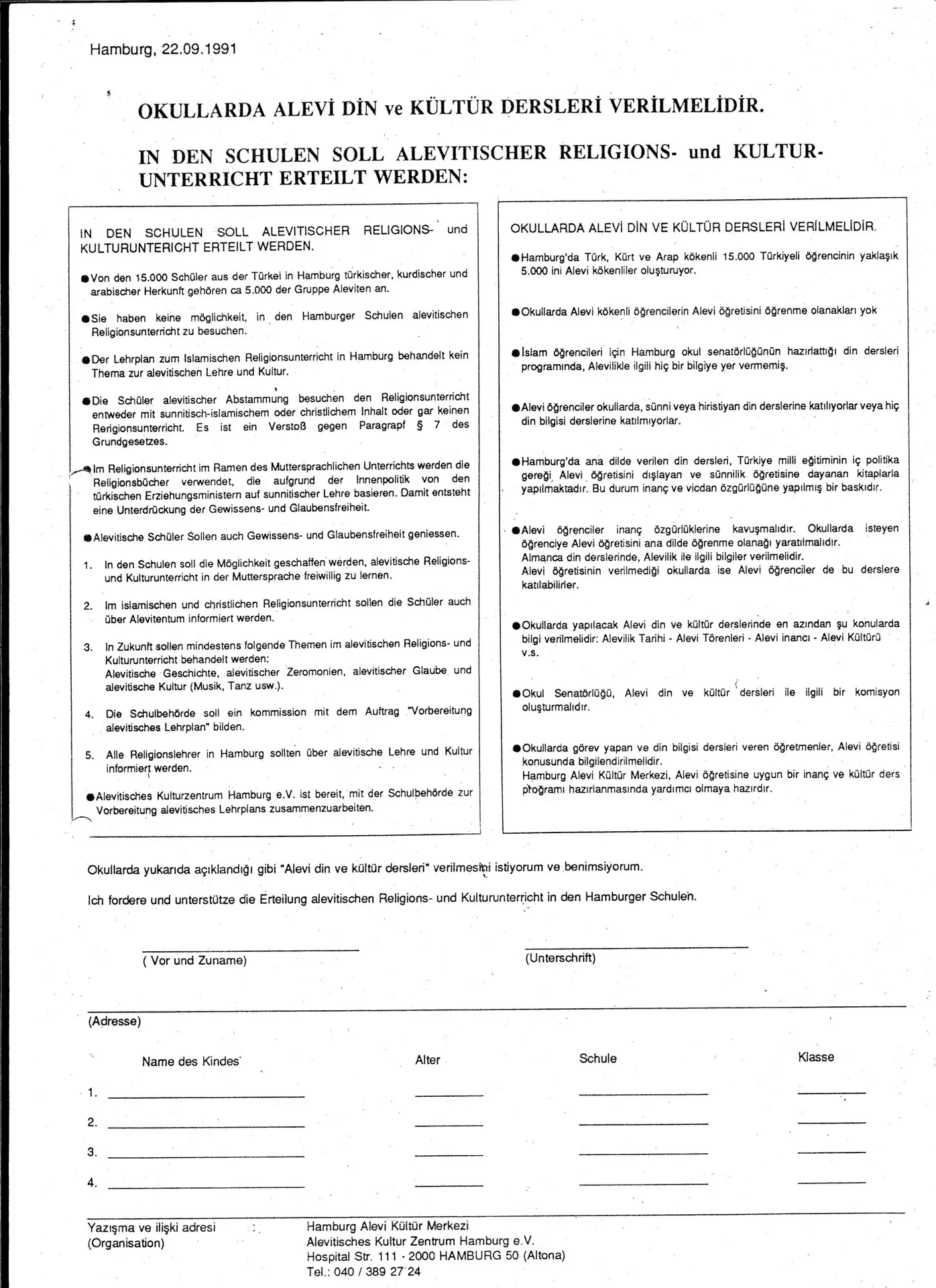
In line with this, on 22 September 1991 the Hamburg Alevi Cultural Centre launched a signature campaign demanding that classes be offered on Alevi belief, culture, rituals, and history for approximately 5,000 Alevi students attending schools in Hamburg. As a result of this initiative, in 1995 the institution became a member of the Interfaith Council, established under the leadership of the Protestant Church and forming the basis of Hamburg’s interfaith religious education model. The Hamburg example thus stands out as the state in which the demand for Alevi religious education was first articulated in concrete terms, transferred onto an organisational footing, and brought onto the agenda of institutional negotiations in the field of religious education.
The Legal and Constitutional Framework
The recognition of Alevi religious education in Germany as a religion class (Alevitische Religionsunterricht, ARU) is directly connected to the German education system and constitutional order. Since religion classes in schools affect promotion to the next grade just like other subjects, authority in practice lies with the education ministries of the federal states. At the same time, religion classes possess a special constitutional status within the secular state structure.[1] For this reason, not only state legislation but also the provisions of the German Basic Law concerning freedom of religion and religious instruction are decisive in the formation of religion classes.
Within this framework, Article 4 of the German Basic Law guarantees freedom of belief, while Article 7, paragraph 3, stipulates that religion classes are to be taught in accordance with the content approved by the relevant religious community. In such a system, the state is responsible for the pedagogical and constitutional framework of religious instruction; however, the faith content of the class is determined by the relevant faith community. Students’ participation in religion classes is also directly dependent on parental decision until the age of fourteen. This gave the demands of parents and the representative character of Alevi institutions a central and decisive role in the development of Alevi religious education.
The ruling of the Constitutional Court dated 25 February 1987 also appears to have been an important point of reference regarding the scope of the religion class envisaged by the constitution in Germany. According to this ruling, religion class is not a culture lesson that treats religious teaching in a supra-denominational and merely comparative way. Nor can it be understood solely as instruction in morality, tradition, or history. This made clear that Alevi religious education should not be designed as an ordinary culture lesson, but rather as a faith-based religion class in the constitutional sense.
Thus, the debate on Alevi religious education in Germany was not merely about the need for a new lesson for Alevi children. It also raised the following question: is Alevism recognised within the German legal order as a faith possessing its own distinct teaching, and is the AABF accepted as the legitimate interlocutor representing this faith? The debates, objections, and expert reports that emerged in the subsequent period essentially concentrated on answering these two questions.
The Initiatives of the Federation of Alevi Unions in Germany (AABF) and the Transfer of the Process to the Federal Level
Following the first initiatives in Hamburg, the issue of Alevi religious education became one of the main agenda items of the Federation of Alevi Unions in Germany (AABF) in the second half of the 1990s. This made it necessary to find and coordinate solutions on a federal scale for demands raised at the local level. The AABF’s initiatives in the field of education focused on ensuring that Alevi children receive education about their own faith and culture within the school system and within the framework of a constitutionally guaranteed religion class. After 1995, this aim was no longer conceived as a temporary or local solution, but as a permanent and institutional right at the federal level. Accordingly, in 1999 the AABF established its professional staff that would create the groundwork for Alevi religious education and ensure its continuity.[2]
Within this framework, on 20 March 1999 the AABF decided to establish a curriculum commission composed of teachers, pedagogues, and religious leaders.[3] The task of the commission was to prepare a draft curriculum for a religion class specific to Alevism. The work began with the identification of the main themes considered essential for students to receive. Later, the units prepared by members were discussed in joint meetings, and at the end of two years of work, in May 2001, the draft “Alevi Religious Education Curriculum” was presented to the organisation. This initiative shows that the AABF was beginning to act not only as an institution demanding rights, but also as an interlocutor institutionally preparing the content of the class.
The AABF’s initiatives gained momentum from 2000 onward through applications to the federal states. Following the court decision allowing the Islamic Federation in Berlin to offer Islamic religious education in primary schools, the possibility that some Alevi children might be directed to these classes increased the sense of urgency for the AABF. Thereupon, on 17 March 2000 the AABF, together with the Berlin Anatolian Alevis Cultural Centre, submitted an application to the Berlin Senate Department for Education, Youth, and Science for Alevi religious education. Similar applications were made in Baden-Württemberg, Hesse, Berlin, and Bavaria in the same year and the following period, and in North Rhine-Westphalia in 2001. In this way, the demand for Alevi religious education ceased to be limited to a particular city and turned into a coordinated, multi-state process.
The decision of the Berlin Senate Department for Education on 17 April 2002 to grant the Anatolian Alevis Cultural Centre permission to offer “Alevi Religious Education” in Berlin schools is regarded as the first concrete legal-institutional gain of the process. With this decision, Alevism began to be taught for the first time in Germany with the status of a school subject. Yet this decision alone did not automatically bring Alevi religious education into operation. A great many practical tasks had to be fulfilled in a short period of time, including identifying potential schools, informing parents, collecting student applications, selecting teachers, and training them in accordance with the curriculum. This shows that the acceptance of Alevi religious education required not only legal recognition, but also an intensive process of organisational mobilisation.
Internal Reservations and External Objections
The process of Alevi religious education was shaped not only by institutional advances, but also by various reservations and objections. Some of these objections came from within the Alevi community, while others came from institutions outside Alevism and from state bureaucracies. The process must therefore be understood not only as a struggle for educational rights, but also as a struggle over representation, recognition, and legitimacy.
The most prominent of the external objections can be seen in the stance of DİTİB, the German branch of the Presidency of Religious Affairs. In official meetings, DİTİB argued that Alevis were Muslims and therefore claimed that there was no need for a separate Alevi religion class. In addition, it was asserted that the AABF was “an organisation of leftist origin,” that it was “not sufficiently concerned with matters of faith,” and that for this reason it could not be regarded as the legitimate interlocutor representing Alevis. This approach may be seen as the reflection, in the field of religious education, of a monist understanding that seeks to dissolve Alevism within Sunni Islam.
The issue of representation was not limited to DİTİB. State education ministries also acted cautiously on the question of whether the AABF represented all Alevis. During this period, it was stated that more than ninety Alevi associations were members of the AABF and that this number was steadily increasing. At the same time, however, the fact that some associations linked to the CEM Foundation remained outside the AABF at the end of the 1990s, and that formations such as the Kurdish Alevi Federation, supported by Kurdish political circles, also emerged, prolonged the discussions over representativeness in the eyes of the ministries. For this reason, decisions concerning Alevi religious education were spread over a long period of time.
The reservations seen in the education ministries were related partly to lack of knowledge and partly to bureaucratic caution. Since many German officials were insufficiently familiar with the AABF and with Alevism, they tended to adopt a position closer to DİTİB’s arguments and assumed that Alevi students could attend Islamic religion classes. For a time, the idea of integrating Alevism into Islamic religion classes, rather than recognising it as a distinct faith and a distinct school subject, appeared to some circles to be a more practical solution. Yet this approach contradicted the right and demand of the Alevi community to define its own faith teaching independently. For this reason, the prolongation of the process of Alevi religious education was influenced not only by legal questions, but also by the fact that the institutional representation of Alevism had not yet fully matured.
Expert Reports and the Acceptance of Alevi Religious Education
Following the applications submitted by the AABF to various federal states, especially North Rhine-Westphalia, Bavaria, Hesse, and Baden-Württemberg decided in December 2001 to commission expert reports in order to reach decisions on the petitions. This stage constitutes a turning point in the process of Alevi religious education. The matter was now beginning to be assessed not merely at the level of demands and objections, but through scholarly reports prepared from the perspectives of religious studies and law.
In this context, on 23 November 2001, Prof. Dr. Ursula Spuler-Stegemann, head of the Institute for the Study of Religion at Marburg University, was asked to prepare a report on “Alevism and the AABF from the Perspective of Religious Studies.” Spuler-Stegemann carried out a comprehensive evaluation by taking into account not only written sources, but also the work of the AABF and the views of Alevi groups outside the AABF. In the 65-page report she submitted to the North Rhine-Westphalia Ministry of Education on 21 July 2003, Spuler-Stegemann provided extensive information on the teaching of Alevism and on the AABF, thereby establishing a framework that opened the constitutional path for Alevi religious education. This report appears to have become one of the first fundamental reference texts in the institutional debates on Alevism in Germany.
Following the religious studies report, a second evaluation from a legal perspective was commissioned from Prof. Dr. Stefan Muckel, head of the Institute for Church Law at the University of Cologne. In his report, Muckel also adopted the main conclusions of the first report. Both reports emphasised that “Alevism, while predominantly of Islamic origin, constitutes a distinct faith,” and that for this reason it could be taught in schools as a subject in its own right, while the AABF could be recognised as the faith organisation of Alevis in Germany. This conclusion proved decisive not only for the legitimacy of Alevi religious education, but also for the status of the AABF as the recognised interlocutor.
Following the publication of the reports, the federal states announced through North Rhine-Westphalia on 2 December 2004 that they would accept Alevi religious education in light of these evaluations. In this way, after a long period of applications and review, the demand for Alevi religious education was accepted by the states within a constitutional and institutional framework. With this decision, the AABF would assume active responsibility in areas such as curriculum development, teaching materials, and teacher training, while also taking a direct role together with the education ministries in the organisation of the classes. This development marked a historical threshold, as for the first time Alevi children were able to learn their own faith in schools within the framework of an official school subject at the federal level.
The Joint Commission, Preparations for Implementation, and the Formation of the Curriculum
Following the expert reports, the education ministries established, together with the AABF and in accordance with Article 7, paragraph 3 of the German Basic Law, a joint commission to determine the conditions for the implementation of Alevi religious education. The commission worked in three main areas: “the identification of Alevi students,” “the preparation of the curriculum,” and “the selection and training of teachers.”
One of the first steps was the identification of students eligible to take part in the classes. Through application forms distributed in Alevi Cultural Centres in four federal states, the AABF introduced Alevi religious education and sought to identify students between the ages of six and twelve. During this process, many Alevi associations organised meetings, formed commissions, and set up small teams to inform parents. By 2004, a total of 3,680 Alevi students had been reached in eighteen cities across four federal states.
The curriculum work goes back to the first curriculum commission launched by the AABF in 1999. This first draft identified the basic subject areas of the class before its formal acceptance and later provided the groundwork for the curriculum development to be carried out with the federal states. The preparation of the lesson plan for Alevi religious education in schools took concrete form especially in North Rhine-Westphalia. It was envisaged that the curriculum for grades 1 to 4 in primary school would first be developed in this state by a joint commission formed together with the AABF and would then be adapted by the other states. In this commission, pedagogues and teachers proposed by the AABF worked together with experts from the Ministry of Education, and the commission continued its work until June 2007.
Various difficulties arose during the preparation of the curriculum. It was not easy to establish German equivalents for the many concepts belonging to Alevism; debates emerged over which concepts of Turkish, Kurdish, Arabic, and Persian origin should be translated and which should be preserved in their original form. In addition, the limited written sources and the diversity of interpretations within Alevism raised the question of how the lesson content could be brought into a common framework. For this reason, the commission turned toward developing a minimum and shared curriculum based on rızalık, that is, on the principle of consensus in Alevism.
Particular care was taken in the prepared curriculum to reflect the plural structure of Alevism. In line with the principle “Yol bir, sürek bin bir” (“The path is one, the practices are a thousand and one”), when more than one interpretation existed on a given matter, these were to be presented to students without establishing a hierarchy of right and wrong. In accordance with the German Basic Law, the language of instruction was determined as German; at the same time, however, it was intended that students should learn the basic concepts of Alevism both in their original forms and through their German equivalents. In this way, the classes were designed to enable Alevi students both to understand their own world of faith and to communicate it to others within the school environment.
Teacher Training and Institutionalisation
Teacher training plays a central role in the institutionalisation of Alevi religious education. As a faith-based institution, the AABF acts not only as the authority responsible for the content of the classes, but also as the recognised interlocutor responsible for teacher selection and the content of teacher training. In the initial phase, Alevi teachers who had studied at teacher training colleges in Germany and were already working in schools with the approval of the state education ministries were identified, and their rızalık was obtained for teaching Alevi religious education. Since 2008, these teachers have been receiving special training in Alevism in order to teach Alevi religion classes at the primary-school level, and they have been awarded certificates upon completion. Within this training, Alevi pedagogy and Alevi didactics are taught within the framework of the class curriculum.
This certificate-based model, adopted out of necessity, was regarded as a temporary solution. Both the AABF and the education ministries pointed out that, as a long-term solution, Alevi pedagogy needed to be taught directly within teacher training colleges. For this purpose, in 2010 the AABF applied to the Weingarten University of Education in Baden-Württemberg for the establishment of courses in Alevi pedagogy. As a result, in the summer semester of 2011 the programme entitled Lehrgang Alevitische Religionspädagogik began to be offered as an additional course for students training to become teachers. In 2013, this model was transformed into a permanent teacher training programme, and teacher candidates studying there began to receive diplomas and to gain the qualification to teach Alevi religious education in schools. In this way, Alevi religious education began to become institutionalised not only at the level of implementation, but also at the level of teacher formation.
Another important dimension of this process of institutionalisation is that Alevism has become a subject of research and teaching at the university level. For the first time in Germany, Alevism began to be taught as a field of research and instruction at the University of Hamburg in the 2015/16 academic year. Alevi teachers trained within this framework teach within the common religion classes in Hamburg and in Alevi religion classes in other federal states. This development shows that Alevi religious education has not only produced teachers for school practice, but has also gained legitimacy in the field of academic knowledge production on Alevism.
The Spread of Alevi Religious Education across the Federal States and the Current Situation
As of 2026, Alevi religious education is being offered at primary-school level in eight federal states. These are Berlin, Baden-Württemberg, North Rhine-Westphalia, Bavaria, Hesse, Saarland, Rhineland-Palatinate, and Lower Saxony. In the state of Hamburg, by contrast, Alevism is taught within interfaith common religion classes. This picture shows that initiatives initially limited to a few states have gradually spread over a wider geographical area. Although Alevi religious education has developed at different speeds from state to state, the overall trend is clearly one of institutional expansion.
Following its spread at the primary-school level, the transition to lower secondary education also came onto the agenda. In North Rhine-Westphalia, after two years of practical experience, the AABF applied in 2010 for Alevi religious education to be offered in secondary schools as well. In response, the state education ministry established a new joint commission composed of Alevi educational experts and state specialists. The commission completed the curriculum in March 2012, and after it was approved by the governing bodies of the AABF, Alevi religion classes for grades 5 to 10 began in the 2012/2013 academic year. In Baden-Württemberg, Alevi religious education has also been offered in secondary schools since 2014. This shows that Alevi religious education is no longer limited to the introductory level of identity transmission, but has also developed into a teaching framework addressing older age groups.
Participation in Alevi religious education does not depend on whether students’ parents are affiliated with Alevi institutions. Whether or not they are members of Alevi cultural centres, the children of all Alevi families may attend these classes on a voluntary basis. Children born into mixed marriages may also participate. At the same time, however, a certain minimum number of students is required in order for a class group to be established. In general practice, at least eight students are required for grades 1 to 4, while in North Rhine-Westphalia, Bavaria, and Lower Saxony this number rises to twelve. These conditions show that, although Alevi religious education has been recognised as a constitutional right, its practical implementation can still vary depending on population density and the level of local organisation.
The Hamburg example, however, presents a model that differs somewhat from the other federal states. In Hamburg, Alevi students learn Alevism not in a separate class, but within the interfaith common religion course known as Religionsunterricht für alle. In this model, introduced after the Equal Rights State Agreement signed separately in 2012 between the Hamburg Senate and the AABF, as well as Islamic organisations, Alevi topics were incorporated into the curriculum on an equal footing with other faith traditions. Thus, in Hamburg, Alevism has gained visibility less in the form of a separate religion class than within a multi-faith common class model based on equal status.
The Effects of Alevi Religious Education
The effects of Alevi religious education on students appear first and foremost in the context of classroom participation and the expression of identity. According to teachers’ observations, students attending these classes show increased attentiveness, and the rızalık taken especially at the beginning of the lessons contributes to the development of more peaceful and harmonious attitudes among them. In this sense, Alevi religious education supports not only the transmission of knowledge, but also certain moral and social forms of conduct.
For Alevi students, learning about their own faith and culture within the school environment also enables them to express this knowledge without hesitation. Their ability to share the knowledge and values they acquire in class with their schoolmates strengthens their self-confidence. In this way, Alevi identity ceases to be an affiliation experienced only in the private sphere and becomes something visible and expressible within the school setting as well.
The effects of Alevi religious education are not limited to students alone. The fact that students share what they learn in class with their families at home, and that parents themselves acquire new knowledge through the teaching materials their children bring back, shows that intergenerational transmission does not function in only one direction. At times, this even creates a reverse process of learning that moves from children to parents. In this way, Alevi religious education in schools assumes a new mediating role in the transmission of religious knowledge within the Alevi community in Germany.
Alevi religious education also has an impact on social relations. Before the classes began, some school principals and circles around the consulates of the Republic of Turkey expressed concerns that these lessons might create new tensions between Sunni and Alevi parents or students. Yet the experience of later years, in most cases, produced the opposite result. Sunni parents and students showed interest in learning more about Alevism and at times sought information directly from Alevi teachers. This has contributed to the reduction of prejudices against Alevis and to the establishment of more peaceful relations within the school environment.
Similarly, it has been observed that German teachers have shown growing interest in teachers of Alevi religious education and that interfaith dialogue among teachers has become stronger. Alevi parents also appear to show greater interest in joint events and commemorative programmes organised in schools, and more lasting forms of dialogue have developed with other parents in the school environment. For this reason, Alevi religious education functions not only as a classroom teaching practice, but also as a means of facilitating the recognition of Alevism in the local public sphere.
Problems Encountered in Practice
Various structural and organisational problems continue to affect the implementation of Alevi religious education. Foremost among these are difficulties related to organisation. In many cases, it is not possible for every Alevi teacher to teach Alevi religious education in their own school. The main reason for this is that many schools do not have a sufficient number of Alevi students. For this reason, teachers often have to travel to other schools in order to teach these classes. This both increases their workload and makes the continuity of the lessons more dependent on local conditions.
Another problem concerns the initiative of school administrations. Even when the necessary conditions are present, many school principals do not begin Alevi religious education on their own initiative. In order for the classes to be opened, parents must clearly communicate their demand for Alevi religious education as a legally recognised right, alert the school administration, and, with the support of the AABF, indicate a suitable teacher. In this way, both parents and the Alevi Cultural Centres in the respective city are obliged to convince school principals of the necessity and benefits of Alevi religious education as a right.
At the same time, local Alevi institutions do not treat this process merely as an administrative matter. At the beginning of the programme, Alevi Cultural Centres organise ceremonies in schools with the support of school principals, and school administrators, students, parents, teachers, and the local press are invited to these events. In this way, both the content of the classes is introduced to the public and Alevism becomes more visible in the social life of the relevant city. This shows that the practical difficulties encountered in implementation are also being addressed through practices of public recognition.
Conclusion
Alevi religious education in Germany emerged as one of the institutional responses in the field of education to the migrant Alevi community’s demands for freedom of belief, public recognition, and the intergenerational transmission of knowledge. Beginning in the 1980s with families’ concerns over the religious and cultural orientation of their children, this process took on an official structure through the first initiatives in Hamburg, the state-level applications of the AABF, expert reports, the work of joint commissions, curriculum development, and teacher training at universities. In this way, Alevism in Germany has come to occupy the position not only of a faith lived in the private sphere, but also of a field of instruction that is recognised and transmitted within the school system. In this respect, Alevi religious education signifies not only an educational matter, but also an important stage in the institutionalisation of the Alevi presence in Germany in terms of religious representation, public equality, and social dialogue.
Endnotes
[1] Religion–state relations in Germany are regulated within a secular framework based on Article 137 of the Weimar Constitution and Article 140 of the Basic Law of the Federal Republic of Germany (Grundgesetz). Within this system, the state has no official religion; at the same time, freedom of religion and conscience is constitutionally guaranteed, and cooperation with religious communities can be established on the basis of public law.
[2] In August 1999, the AABF leadership appointed İsmail Kaplan to establish the Education and Project Department at its headquarters in Cologne.
[3] Members of the first curriculum commission for Alevi religious education were: İsmail Kaplan (moderator), Celal Aydemir, Hayati Bektaş, Faysal İlhan (Hakk’a yürüme date: 24.12.2015), Veli Aydın, Cevat Ersoy, İsmail Demirtaş, Mustafa Düzgün (until 28.08.1999), and Ahmet Aydemir (until 15.05.1999; Hakk’a yürüme date: 05.04.2015).