Women in Alevism: Between Ritual, Authority and Lived Experience
Women in Alevi cosmology
The position of women in Alevi cosmology is closely connected to the understanding of the human being, the divine and the relationship between them. Rather than beginning with the social roles of women and men, Alevi thought approaches the human being through a broader spiritual understanding of existence. A central concept in this understanding is can. Although often translated as ‘soul’, can refers to the spiritual being that transcends distinctions such as gender, ethnicity and social status. The spiritual path is therefore understood not as the journey of a woman or a man, but of the can. At this fundamental level, women and men are recognised as equal participants in the spiritual journey.
Alongside the concept of can, Alevi cosmology also attributes a distinctive place to women. In Alevi belief, women occupy a central position not only in social life but also at the theological level. One particularly significant articulation of this understanding is offered by Başköylü Hasan Efendi, a twentieth-century Alevi religious scholar and pir from the Dersim-Erzincan region. In his interpretation, woman is regarded as the being through whom Hakk is manifested, while birth is understood not simply as a biological event but as the beginning of existence itself. As he explains, ‘Hakk is proven in birth’, and the Gate of Birth (Doğum Kapısı) is therefore the Gate of Hakk. All existence enters the world through this gate, which is realised through woman. Woman is thus understood as the nişangah (divine sign), embodying hakikat (truth) in the material world. Within this cosmological framework, birth is the visible expression of divine truth, and woman, as its bearer, becomes the earthly reflection of Hakk. She is therefore understood not only as equal or as a socially revered figure, but as a sacred subject of existence and the spiritual path. At this ontological level, she is granted the status of mürşid, the ‘owner and mother of the path’.[1]
The figure of Ana Fatma exemplifies this sacred femininity as a spiritual archetype. Symbolising inner purity and esoteric wisdom, Ana Fatma is associated with beauty, cleanliness and divine light (nur). In Dersim especially, the full moon is seen as her reflection or image. During fullmoon nights, people pray with the invocation ‘Ya asma bumbarekê, ya sıreta Ana Fatma!‘ (‘O sacred moon, O reflection of Ana Fatma!’) and kiss the spots where the moonlight touches the ground three times in reverence.[2] Ana Fatma serves as a spiritual and social role model for Alevi women, affirming their place in religious and communal life.
Women in ritual practice and community life
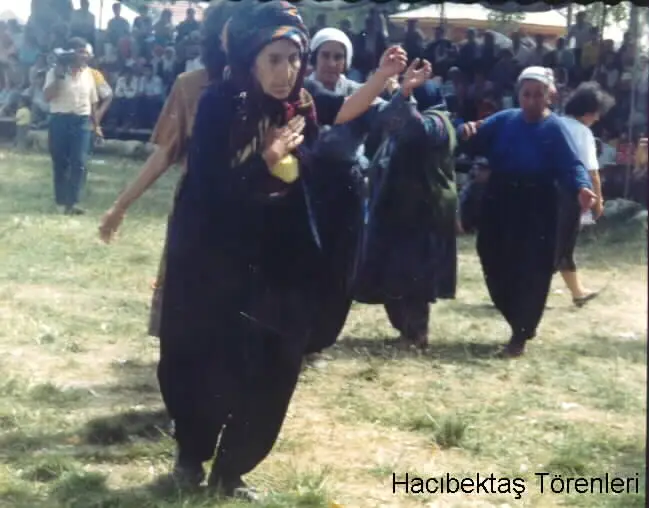
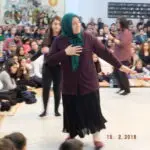
The central place attributed to women in Alevi cosmology raises the question of how these understandings are expressed in religious practice. The cosmological understanding of women and men as can finds expression in Alevi religious practice, particularly in the cem, the principal communal ritual of Alevism. The cem brings together worship, prayer, music, moral teaching and the strengthening of communal bonds. Participants are addressed not primarily as women or men, but as can, reflecting the understanding that what matters is the shared spiritual journey rather than gender. Women and men worship together in the same sacred space, participating equally in prayer, music and ritual. One of the most visible expressions of this shared participation is the semah, performed by women and men together as a symbol of harmony and unity on the spiritual path.
This understanding also extends beyond ritual practice. Alevism does not prescribe gender-specific dress codes for women, and girls have generally enjoyed relatively better social and educational opportunities than in many surrounding societies. These features have often been cited as evidence that Alevism promotes gender equality and have become important markers distinguishing Alevi identity from dominant religious norms in the region. However, these practices cannot be reduced to simple indicators of equality. Within Alevi belief, women and men worship together not merely because equality is valued, but because ritual reflects the understanding of the human being as can, a spiritual being beyond gender.
These practices have also acquired broader significance in contemporary representations of Alevi identity. As Alevis have sought greater public recognition in Turkey and the diaspora, and in response to changing political contexts, shared worship and women’s participation in religious life have increasingly been presented as expressions of secularism, democracy and gender equality (Akdemir 2023; Hanoğlu et al. 2025; Okan 2018; Uyanık 2004; Poyraz 2018).
At the same time, ritual is not only about worship. It is also about creating and sustaining community. Preparing food, organising the cem, welcoming participants, maintaining the ritual space and sustaining communal relationships all depend on collective effort. Much of the everyday work sustaining these activities has traditionally been undertaken by women, both in rural Alevi communities and, more recently, in cemevis across Turkey and the diaspora. Nevertheless, active participation in ritual and community life does not necessarily translate into religious or institutional authority. Understanding this distinction requires attention to the historical organisation of Alevi religious institutions and the wider social conditions in which they developed.
Religious authority and institutional life
The ocak is the traditional institution through which religious knowledge, ritual leadership and spiritual guidance have been transmitted across generations. At its centre are hereditary lineages whose members provide religious guidance to their followers (talips). Within this system, the dominant figure has traditionally been the pir/dede, who leads rituals, offers guidance, mediates conflicts and maintains the continuity of the yol. The prominence of the pir/dede has often led to the assumption that religious authority in Alevism was historically almost exclusively male.
Yet institutional visibility does not necessarily reflect religious legitimacy. Alongside pirs, the ocak system has also recognised the figure of the ana. Like pirs, anas derive their religious legitimacy from belonging to an ocak lineage and are recognised as transmitters of religious knowledge and spiritual guidance. Their existence demonstrates that women’s religious authority has a recognised place within Alevi traditions, even if its institutional expression has historically been far less visible than that of men’s authority.
Like other religious traditions, Alevism developed within patriarchal societies, where prevailing gender relations shaped the organisation of religious authority and limited the institutional visibility of anas, despite their recognised religious legitimacy.
For centuries, Alevi communities were organised across dispersed rural landscapes, where religious leaders travelled long distances to visit their talips and conduct rituals. Such patterns of mobility were shaped by gendered divisions of responsibility, with women generally carrying primary responsibility for childcare and domestic life. Under these conditions, men came to predominate as travelling ritual specialists, while women’s religious authority was more often exercised within local communities and family settings. The historical predominance of male ritual leadership therefore reflected these social and organisational conditions rather than explicit theological prohibitions on women’s authority.
One of the best-known historical examples of women’s religious authority is Anşa Bacı, the nineteenth-century religious leader who established her own ocak and attracted followers known as the Anşa Bacılar (Çakmak 2018; Selçuk 2012). Although figures such as Anşa Bacı were relatively rare, they demonstrate that women could exercise recognised religious authority within the Alevi tradition. However, her authority was not uncontested. Her growing religious authority faced opposition from both Alevi and non-Alevi actors. Accusations brought against her and her family ultimately led to their exile to Damascus in 1887, despite the absence of evidence substantiating the allegations (Çakmak 2018).
The position of women in Alevism cannot be understood through a single dimension, such as religious leadership. Rather, it requires a distinction between cosmological legitimacy, ritual participation and institutional visibility. These dimensions are closely connected, but one does not necessarily translate into another. Women may be theologically recognised and participate actively in ritual life while remaining underrepresented in visible positions of religious leadership. This gap highlights the complex relationship between women’s religious legitimacy and the historical organisation of religious authority in Alevi communities.
Gender equality in everyday life: Between ideals and lived realities
Religious principles and institutional structures provide only part of the picture of women’s position in Alevism. Religion is also lived through families, communities and everyday relationships, where religious ideals are interpreted and negotiated in relation to wider social conditions.
My ethnographic research among Alevi communities in Turkey and the United Kingdom suggests that women’s perceptions and experiences of equality are diverse. On the one hand, many women describe Alevism as providing them with a strong sense of dignity, confidence and belonging from an early age. Growing up in Alevi families, they often experienced relationships between women and men as more egalitarian than those they observed in wider society (Hanoğlu 2025; Hanoğlu et al. 2025). Participation in religious and community life, the relative absence of gender segregation and the emphasis on moral rather than gendered distinctions all contributed to this perception.
On the other hand, these perceptions of equality coexist with important tensions in everyday life. The discourse of equality does not eliminate gendered expectations within families and communities. Alevi women continue to negotiate family and care responsibilities while facing unequal access to leadership positions. These tensions are particularly visible in community organisations. Women are often at the centre of communal life, organising events, preparing communal meals, supporting families and undertaking much of the everyday work that allows cemevis to function. Yet these contributions have not always translated into equal participation in decision-making. In many Alevi organisations, both in Turkey and the diaspora, senior leadership positions have remained predominantly male (Hanoğlu 2021).
These tensions are also reflected in how women understand and reflect upon their own experiences of equality. Many described growing up with the conviction that they were free and equal. Their reflections, however, suggested that this sense of equality was often taken for granted rather than consciously questioned or reflected upon. Such perceptions could also obscure the distinction between participation and authority: women’s active involvement in religious and community life could be mistaken for equal representation, while visibility could be mistaken for influence.
Gender equality in Alevi communities is consequently not simply a condition that exists or does not exist, but something continuously negotiated. Alevi women draw upon religious values that affirm dignity and mutual respect while navigating the realities of family life, education, employment and community expectations. This diversity becomes particularly apparent among Kurdish Alevi women, whose experiences are shaped not only by gender but also by ethnicity, language, migration, education and political history (Hanoğlu et al. 2025; Hanoğlu 2025). These intersecting experiences create different opportunities and constraints, demonstrating that there is no single way of being an Alevi woman.
Migration, institutionalisation and changing gender relations
None of these negotiations, however, take place in isolation. Like every living religious tradition, Alevism continues to evolve as its communities respond to changing social, political and cultural conditions. Migration to cities and Europe, new educational and social opportunities, the institutionalisation of Alevism and its struggles for public recognition, and growing engagement with debates on gender equality have all reshaped the contexts in which Alevi women understand and negotiate their roles.
As Alevi communities have moved from rural villages to towns, cities and diasporic settings, religious life has taken new institutional forms. The establishment of cemevis, the expansion of Alevi organisations and greater engagement with public institutions have created new opportunities, but also raised questions concerning participation, leadership and representation. At the same time, life in metropolitan and transnational settings has exposed Alevi communities to new legal frameworks, educational opportunities and public debates about gender and equality. In these new institutional and social settings, practices once taken for granted have increasingly become subjects of reflection, interpretation and sometimes reform.
The growing visibility of women in community organisations and religious institutions reflects this broader process of transformation. In some Alevi organisations, particularly in the diaspora, co-presidency models have been introduced to promote more balanced representation in leadership (Hanoğlu 2021). At the same time, Anas have become increasingly visible in both Turkey and the diaspora, assuming more prominent roles in religious practice and authority. They are now more commonly seen giving gülbenk (gulbang), lighting the çerağ, co-leading cem rituals alongside pirs and offering spiritual guidance. These developments, however, remain uneven across Alevi communities and institutions. Nevertheless, they illustrate how religious authority continues to be reinterpreted as Alevi communities respond to changing social realities.
Conclusion
Women occupy a significant place in Alevi cosmology, participate actively in ritual practice and sustain much of communal life. Yet their institutional visibility has historically been more limited. This disparity highlights how cosmology, ritual participation, institutional authority and lived experience do not necessarily develop at the same pace. Understanding women’s position in Alevism therefore requires examining the relationships between these interconnected dimensions.
This perspective avoids presenting Alevism either as a fully realised model of gender equality or as a tradition defined by inequality. Instead, it reveals a more dynamic picture in which religious ideals provide important resources for women’s agency, while everyday life remains a space of adaptation, reinterpretation and sometimes contestation.
The position of women in Alevism is therefore neither fixed nor reducible to simple claims of equality or inequality. It continues to be negotiated as communities reinterpret inherited traditions within changing historical and social contexts. Continuity and change coexist as Alevi women draw upon long-established religious principles while simultaneously shaping new forms of participation, leadership and agency.
Akdemir, Ayşegül. 2023. ‘The Construction of Gender Identity in Alevi Organisations: Discourses, Practices, and Gaps’. Ethnography 24 (4): 474-95.
Çakmak, Yalçın. 2018. ‘Kızılbaş/Alevî Toplumunda Yeni Bir Ocak ve Topluluğun İnşası: Anşa Bacı ve Keçeli Sıraçlar’. Alevilik-Bektaşilik Araştırmaları Dergisi, no. 18 (December): 225-58. https://doi.org/10.24082/2018.abked.194.
Hanoğlu, Hayal. 2021. ‘Remaking Alevism in Diaspora: The Socio-Spatial Dynamics of Migrant Alevism in the UK.’ PhD. PhD Thesis, Unpublished, University of Kent, Canterbury, UK.
Hanoğlu, Hayal. 2025. ‘Dersimi Women, Family, and Activism: Navigating and Negotiating Alternative Spaces’. In Enacting Citizenship: Kurdish Women’s Resilience, Activism and Creativity, by Wendelmoet Hamelink, Joanna Bocheńska, Dobrosława Wiktor-Mach, et al. Palgrave Macmillan.
Hanoğlu, Hayal, Nerina Weiss, and Karol Kaczorowski. 2025. ‘The Roads to Empowerment: An Intersectional Analysis of Kurdish Alevi Women’s Struggle for Equality and Freedom’. Cogent Arts & Humanities 12 (1): 2483582. https://doi.org/10.1080/23311983.2025.2483582.
Okan, Nimet. 2018. ‘Thoughts on the Rhetoric That Women and Men Are Equal in Alevi Belief and Practice (Alevilik)-to Songül’. National Identities 20 (1): 69-89.
Özcan, Pir Sultan. 1992. Varlığın Doğuşu / Beyan Eden Başköylü Hasan Efendi. Anadolu Matbaası.
Poyraz, Bedriye. 2018. ‘Hakikatin Darına Durmak – Giriş’. In Hakikatin Darına Durmak. Dipnot Yayınları.
Selçuk, Ali. 2012. ‘Merkezi Kurumsal Otoritenin Ötekileştirdiği Bir Topluluk: Anşa Bacılar (A Community Otherised by the Central Institutional Authority: Anşa Sisters)’. Türk Kültürü ve Hacı Bektaş Velî Araştırma Dergisi, no. 61.
Uyanık, Zeki. 2004. ‘Alevilik, Aleviler ve Kadin’. Hacı Bektaş Veli Araştırma Dergisi 32: 29-35.
Yürür, Gülkızılca. 2021. ‘Ana Buyere’nin Kırk Meleği – Dersim Alevileri’nin Kozmolojisinde Doğum, Ölüm ve Ölümsüzlük’. Alevilik-Bektaşilik Araştırmaları Dergisi, no. 23 (July): 81-112. https://doi.org/10.24082/2021.abked.313.
License information
© The Author(s). Unless otherwise stated, entries published in the Alevi Encyclopedia are licensed under a Creative Commons Attribution 4.0 International License.