Demokratik Barış Hareketi (The Democratic Peace Movement) and Barış Partisi (the Peace Party) (1995–1999): The Quest for Representation in Alevi Politics
The Emergence of Alevis as a Visible Political Actor
From the time of the 1987 constitutional referendum onwards, Alevis acquired a new visibility in Turkish politics. This visibility was not simply a consequence of the proliferation of Alevi associations, foundations, and publications. It was also related to the growing tendency of political parties to regard Alevis as a distinct electoral constituency. Press reports that President Turgut Özal met prominent Alevi figures in Gölbaşı in November 1990, soon after his election to the presidency, and Prime Minister Tansu Çiller’s commissioning of a report on Alevism and contacts with circles associated with the Cem Foundation when an early election came onto the agenda in 1995 were among the highest-level political manifestations of this new interest. Politicians and candidates of Alevi background were becoming important not only to social democratic parties but also to parties on the centre right and within the nationalist-conservative camp (Massicard 2005).
Nevertheless, this visibility did not mean that Alevis had become permanently integrated into any particular party. The fact that 27 of the SHP’s (the Social Democratic Populist Party, Sosyaldemokrat Halkçı Parti) 88 members of parliament between 1991 and 1995 were Alevi, together with the presence of Alevi ministers in the cabinet, created an impression of strong representation. Despite this, there was marked dissatisfaction among Alevi organisations with what they saw as the social democratic parties’ failure to give sufficient support to their demands concerning the Directorate of Religious Affairs, compulsory religious education, equal citizenship, and discrimination (Şahhüseyinoğlu 2001). Meanwhile, efforts by circles associated with the Motherland Party (Anavatan Partisi, ANAP), the True Path Party (Doğru Yol Partisi, DYP), the Nationalist Movement Party (Milliyetçi Hareket Partisi, MHP), and even the Welfare Party (Refah Partisi, RP)to reach Alevi voters through candidates and representatives demonstrated that Alevis were becoming an increasingly significant object of party-political competition. As Massicard observes, “political parties had been unable to bind Alevis fully to themselves or establish lasting alliances with them” (Massicard 2005, 207).
The situation that emerged in the mid-1990s should therefore not be understood solely as the “politicisation of Alevis”, but as a two-way process. On the one hand, the political system was discovering Alevis and courting their votes. On the other, Alevi society was increasingly questioning the extent to which the left-wing and social democratic parties with which it had traditionally maintained close relations represented its particular demands. While this situation created new opportunities for representation, it also raised important questions about the political course that this newly acquired visibility would follow. In other words, Alevis were becoming a visible political actor, but the organisational and party-political channel into which this visibility would be directed remained uncertain.
Sivas and Gazi: The Traumatic Ground of the Search for Representation
This political search developed during a period in which Alevis were exposed to severe political violence. Cem magazine’s call for an “Alevi Congress” in July 1992 and a meeting held before the Hacıbektaş Festival on 15 August 1992, which brought together representatives of Alevi organisations from Turkey and abroad, demonstrate that efforts to create a common platform for presenting shared demands to the public had begun before Sivas. These meetings formulated demands for a democratic constitution that would guarantee equality for all, the separation of state and religion, the restructuring of the Directorate of Religious Affairs, the abolition of compulsory religious education, and the correction of distorted information about Alevi-Bektashi belief and culture (Çamuroğlu 1992, 16; Şahhüseyinoğlu 2001, 278-290). This set of demands would remain among the central and largely unchanged demands of the Alevi movement, which was acquiring a political form during this period, for the following four decades.
The arson attack on the Madımak Hotel on 2 July 1993 and the deaths of 33 participants who had come to the city to attend the Pir Sultan Abdal Cultural Festival, held in central Sivas for the first time that year, together with two hotel employees, fundamentally transformed the context of this organisational process. An inter-organisational meeting planned for August 1993 in Hacıbektaş was cancelled because of Sivas. At a broadly attended meeting held in October 1993, however, the idea of establishing an “assembly of representatives” came to the fore. This suggests that the Sivas Massacre of 2 July accelerated the search for coordination between Alevi organisations in Turkey and abroad. The issue was no longer limited to religious recognition or cultural rights. The physical safety of Alevis, the neutrality of the state, and effective representation within the political system had also become part of the political agenda of the Alevi movement.
The events that began in Istanbul’s Gazi neighbourhood on 12 March 1995, spread to other districts such as Ümraniye, lasted for three days, and resulted in the deaths of 22 people further deepened this sense of vulnerability. The two-year period between Sivas and Gazi also witnessed the rise of the Welfare Party (Refah Partisi, RP) in the 1994 local elections, its capture of the municipalities of Istanbul and Ankara, and the intensification of debates over secularism. It would therefore be inadequate to explain Alevi organisation in the mid-1990s solely through the rise of identity politics. The distinctive form of organisation referred to here as the Alevi movement was shaped, on the one hand, by growing public visibility and new political opportunities and, on the other, by concerns over security and representation arising from traumatic experiences of violence such as Sivas and Gazi.
The Search for a Common Political Language Between Turkey and Europe
In this context, intensive contact and a search for coordination developed between Alevi organisations in Turkey and Europe. Alevi organisation in Europe, particularly in Germany, had rapidly become institutionalised from the late 1980s onwards, although it had not yet reached an internal consensus regarding the course it should follow. While the traditional wing considered it sufficient to sustain Alevism within the private sphere, a younger and more progressive wing-many of whose members had moved to Europe following the military coup of 12 September 1980-argued that Alevism should acquire public visibility. The experience of establishing associations and federations and seeking public recognition under conditions of migration provided actors in Europe with a different organisational repertoire (Gül 1999; Kaçmaz 2018). Relations established with associations and foundations in Turkey became one of the channels through which this repertoire was transferred to the Alevi movement there.
A meeting held in Ankara on 29-30 April 1994, with the participation of the Pir Sultan Abdal Cultural Association, organisations associated with Hacı Bektaş Veli, and European Alevi organisations, was an important example of this growing cooperation. The meeting discussed the establishment of an “umbrella organisation” and direct political intervention in problems affecting Turkey. Circles associated with the federation in Germany publicised this initiative as the “Secular Democratic Bloc Movement” (Laik Demokratik Blok Hareketi) and regarded it as a democratic mobilisation in response to the results of the local elections of 27 March 1994. The demands were not limited to matters concerning Alevis. They included ending the domination of religion over the state, abolishing compulsory religious education, securing freedom of religion and conscience and human rights, and ensuring equality between Turks and Kurds and between Alevis and Sunnis.
One institutional expression of this search for coordination was the Assembly of Alevi-Bektashi Representatives (Alevi Bektaşi Temsilciler Meclisi, ABTM). The ABTM sought to bring Alevi-Bektashi organisations in Turkey and abroad together on a common platform of representation. The framework entitled “What Kind of Turkey Do We Want?”, announced in Ankara in July 1995, emphasised pluralist democracy, the recognition of Alevism, the implementation of international human rights instruments in domestic law, and equality in the provision of religious services. In the aftermath of Sivas and Gazi, Alevi organisations thus sought not merely to develop a defensive form of identity politics but to establish a broader political language that connected their own problems to the democratisation of Turkey.
A Decisive Split Between the Alevi Movements in Europe and Turkey: The Means of Political Intervention
Although a degree of convergence had been achieved around common demands, serious disagreement persisted over the means through which these demands should be carried into politics. At the centre of this debate was the question of a “political party”. One position argued that the influence of associations and foundations had clear limits, that parliament was ultimately the place in which Alevi problems could be resolved, and that direct political organisation was therefore necessary.
Ali Rıza Gülçiçek, chair of the ABTM, had begun his political involvement as a migrant in German trade unions and had also served for a period as general secretary of the Federation of Alevi Unions in Germany (Almanya Alevi Birlikleri Federasyonu, AABF). He would later enter parliament as a CHP (the Republican People’s Party, Cumhuriyetçi Halk Partisi) representative for Istanbul following the general election of 3 November 2002. His statement that “if we had had 80 members of parliament in the Grand National Assembly of Turkey, they would have proclaimed our problems at the top of their voices” summarised this approach (Gülçiçek 2018).
By contrast, circles associated particularly with the Pir Sultan Abdal Cultural Association (Pir Sultan Abdal Kültür Derneği, PSAKD) argued that a party based on Alevi identity would be perceived as sectarian and would divide democratic forces. Rather than withdrawing from politics, this approach proposed influencing existing democratic forces through pressure-group activity and lobbying. This distinction became more explicit during the Hacıbektaş meetings of 1995: “yes” to becoming a pressure group in politics, but “no” to an independent political party based on Alevis. The debate was therefore not about whether Alevis had political demands, but whether those demands should be represented through an independent identity-based party or within broader democratic alliances (Ertan 2017; Ertan 2023).
The independent-candidate formula initially supported by organisations in Europe appeared to offer a middle path between these two approaches. The aim was to make Alevi demands visible during the election period and send representatives to parliament without establishing an “Alevi party”. With an early election announced for the end of the year, this idea rapidly assumed a concrete form in the autumn of 1995, and independent candidates were selected to stand in 21 provinces.
The DBH Crisis and the Breakdown of Turkey-Europe Coordination
In an announcement issued on 3 November 1995, the ABTM brought forward a meeting that had previously been planned for 6-7 November. Those opposed to establishing a party claimed that this decision had been taken to restrict participation. The fact that not all organisations were able to attend because the meeting had been brought forward led to controversy over the legitimacy of the decision to establish a party. During the same period, the financial support of businessman Ali Haydar Veziroğlu became decisive.[1] The financing of flights for participants travelling from Europe and the gradual transformation of the independent-candidate strategy into a political formation led by Veziroğlu caused serious unease, particularly among representatives of European organisations.
The meeting held on 25 November 1995 under the name “Democratic Peace Movement” brought these tensions into the open. Participants argued that “there can be no democracy without peace”, that differences of descent, belief, and class should cease to be sources of conflict, and adopted the slogan “Our first names may differ, but our surname is Türkiye”. Nevertheless, representatives from Europe left the meeting in protest, believing that the DBH had come under Veziroğlu’s control. Several individuals who had been considered as candidates from Europe withdrew, while representatives serving on the provisional executive resigned. One of the most significant figures among them was undoubtedly Turgut Öker, who would assume the leadership of the AABF shortly after this rupture and shape the European Alevi movement for the following two decades.[2]
Veziroğlu’s last-minute decision not to contest the election appeared to vindicate these concerns. The CHP had only narrowly crossed the 10 per cent electoral threshold in the 1995 election, and Veziroğlu’s withdrawal was interpreted in light of this outcome (Gül 1999; Şahhüseyinoğlu 2011; Ertan 2017).
On 2 December 1995, the AABF evaluated the process at a meeting attended by 74 member organisations and announced that it no longer maintained any organisational relationship with a political formation in Turkey. No representatives from Europe attended the meeting held in Ankara in January 1996 to discuss the future of the ABTM. The holding of an extraordinary general assembly in Germany in February 1996 further demonstrated that the DBH process had also generated serious internal debate within the European organisation (Gül 1999; Kaçmaz 2018).
These developments make it difficult to define the DBH simply as “a party established in Turkey by European Alevi organisations”. It is more accurate to understand it as an initiative that emerged from several years of efforts to establish Alevi coordination between Turkey and Europe but which, upon reaching the threshold of forming a political party, caused this coordination to fragment. In other words, relations between Turkey and Europe had advanced through the formulation of common demands and the effort to create a common mechanism of representation. When confronted with the question of “which political means should be used to intervene”, however, these relations faced their first major test and seriously unravelled. This rupture became one of the factors that led European Alevi organisations to pursue their own institutional trajectory in subsequent years, while organisations in Turkey turned towards different forms of alliance and representation (Şahhüseyinoğlu 2011; Zırh 2015).
From the Democratic Peace Movement to the Peace Party
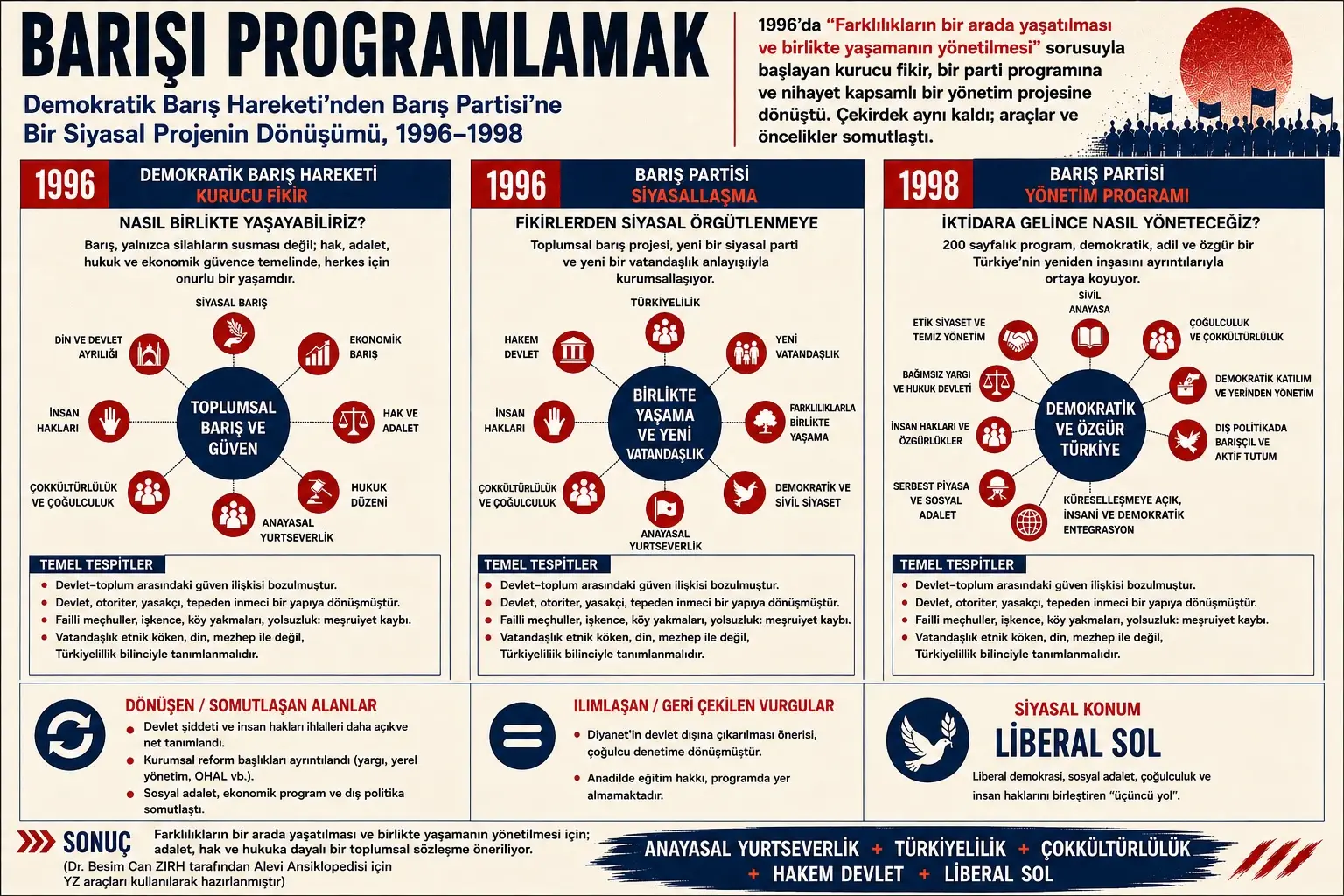
When the establishment of the DBH was publicly announced on 25 November 1995, its presentation carefully avoided placing emphasis on Alevi identity. The appointment of Mehmet Eti, a professor of medicine who was not an Alevi, as chair was one symbolic indication of this preference. On 14 July 1997, Eti handed the position over to Abidin Özgünay. Known from circles associated with Cem magazine, which had been established in the 1960s, Özgünay stepped down for health reasons on 31 December 1998 and transferred the chairmanship to Ali Haydar Veziroğlu. Following its unsuccessful electoral result, the Peace Party dissolved itself on 9 May 1999 and donated all its assets to the Ministry of National Education.
The involvement of figures from within the Alevi movement, such as Reha Çamuroğlu, in preparing the programme, together with contacts established with individuals from different academic and political circles, including Doğu Ergil, Taner Akçam, Yekta Güngör Özden, and Zafer Üskül, reflected the movement’s desire to present itself not as a sectarian party but as a political project offering solutions to Turkey’s broader problems.
Nevertheless, the DBH’s policy on religion displayed strong continuity with the demands articulated by the Alevi movement since 1992. Its programme advocated removing the Directorate of Religious Affairs from the state apparatus, transferring the institution to religious communities, and allowing the relevant communities themselves to determine the principles of representation and financing. On 25 October 1996, the Chief Public Prosecutor’s Office of the Court of Cassation filed a closure case against the party on the grounds that this provision violated Article 89 of the Political Parties Law. Without waiting for a decision, the DBH leadership established a new party, and the Peace Party emerged in December 1996. The formulation concerning the Directorate of Religious Affairs that had led to the closure case was omitted from the new programme. The Constitutional Court concluded the case against the DBH by a majority vote on 22 May 1997 (Hakyemez 2001, 49-69).
This transition reveals a second major boundary in the history of the movement. The first concerned the debate among Alevi organisations over whether to operate as a political party or a pressure group. The second concerned the legal limits imposed by the political-party regime on the demands that could be expressed programmatically. As demands formulated within the field of Alevi organisation were translated into party politics, they were thus subjected both to internal divisions within the movement and to legal intervention by the state.
Programmatic Identity: Alevi Demands, Türkiyelilik, and Pluralism
The Peace Party’s 1996 document Temel Yaklaşımlar (Core Princibles) clearly illustrates the distinction between the movement’s Alevi origins and its programmatic self-definition. The document does not reduce Turkey’s fundamental problems to the Alevi question, the Kurdish question, or secularism alone. Instead, it targets the crisis of trust between state and society and a homogenising conception of citizenship. Türkiyelilik emerges as the central concept of a shared political belonging. Divisions between Turks and Kurds, Alevis and Sunnis, and secularists and anti-secularists are treated as different axes of the same identity crisis. The proposed solution is not the elimination of differences but the democratic management of coexistence.
Alevis are explicitly discussed in the programme, which addresses historical oppression, disparaging and inaccurate representations of Alevi beliefs, equal citizenship, and freedom of religion. Alevism, however, does not function as the party identity that organises the text as a whole. The discussion of Alevis is concentrated primarily in the section entitled “Ethnic and Cultural Identities”, where Kurds and non-Muslims are also considered within the same framework of pluralist citizenship. The Alevi question is therefore one of the programme’s foundational issues, but Alevism is not the party’s foundational identity.
The 1998 Türkiye Toplumsal Barış Projesi: Yeniden Yapılanma Programı (Turkey’s Social Peace Project: Restructuring Programme) developed this approach into a more comprehensive public-policy programme. The party now explicitly defined itself as part of the “liberal left”. It developed detailed proposals for a civilian constitution, the implementation of human rights instruments in domestic law, the abolition of thought crimes, the closure of the State Security Courts, the strengthening of local government, and greater fairness in political representation. Regarding the Kurdish question, it formulated concrete demands including the abolition of the state of emergency, the termination of the village-guard system, and compensation for those affected by village evacuations.
Compared with 1996, however, the programme adopted more cautious language on certain issues. Rather than removing the Directorate of Religious Affairs from the state apparatus, it proposed restructuring the institution under state supervision on a pluralist basis. The emphasis on education in the mother tongue weakened, while references to Atatürk’s principles and the unitary state became stronger. This change can be read in conjunction with the experience of the closure case and the effort to adapt to electoral politics.
The 1999 Elections and the Historical Significance of the DBH/BP
The Peace Party’s principal electoral test came in the elections of 18 April 1999, when general and local elections were held together for the first time. The BP contested the general election in 57 provinces but received only 78,922 votes, or 0.25 per cent of the national total.[3] It received 67,448 votes, or 0.21 per cent, in the provincial general council elections and won only six municipalities. It exceeded 1 per cent of the vote in Ardahan, Tokat, and Tunceli. In Tunceli, the BP received 8.7 per cent of the vote (22,254 votes). In Ovacık, Tunceli-Veziroğlu’s hometown-it received 1,563 votes but lost the municipality to ANAP. Following this electoral failure, an extraordinary congress convened on 9 May 1999 and decided to dissolve the party and transfer its assets to the Ministry of National Education.
Despite being widely perceived in public as an “Alevi initiative”, the BP did not emphasise Alevism in its own self-definition. Its programmes were constructed around pluralism, equal citizenship, and, later, the concept of the liberal left, all framed through Türkiyelilik. Classifying the DBH-BP solely as an “Alevi party” would therefore obscure the most important historical tension within the experience. The party emerged precisely at a moment when Alevis were acquiring visibility as an independent political actor but were experiencing serious divisions over how this actor should be represented. Its emergence was therefore an indication both of the Alevi movement’s growing political capacity and of the organisational limits of that capacity.
The paradox of the experience lies here. The initiative had been developed to carry Alevi problems into parliament, yet it did not place Alevi identity at the centre of its programmatic self-definition because it sought to avoid being perceived as an “Alevi party”. In doing so, it distanced itself from part of the Alevi electorate, but it was unable to dispel the wider public perception that it was an Alevi party. As Ertan observes, the more the BP attempted to demonstrate that it was not an Alevi party, the more it distanced itself from Alevi voters, while failing to convince non-Alevi voters otherwise (Ertan 2023, 162).
The specific conditions of the period must nevertheless be considered when evaluating the BP’s electoral failure. Three major developments in the period leading to the elections of 18 April 1999 are particularly important. First, the “Susurluk crash” of 3 November 1996 exposed relations between the state and organised crime and created a powerful public demand for clean politics. The emergence of the the Freedom and Solidarity Party (Özgürlük ve Dayanışma Partisi, ÖDP) was one expression of this demand. The BP entered alliance negotiations with the ÖDP, but no agreement was reached. Cem Boyner’s New Democracy Movement (Yeni Demokrasi Hareketi, YDH), meanwhile, joined the Peace Party in 1997. Second, the “28 February Memorandum”, issued by the Turkish Armed Forces on 28 February 1997 and described in the literature as a “postmodern coup”, resulted in the government’s resignation. Third, Abdullah Öcalan was captured in Kenya and brought to Turkey on 15 February 1999. Together, these three developments radically transformed the balance of Turkish politics.
From this perspective, the DBH-BP was more than an unsuccessful electoral initiative. It was a political laboratory in which three fundamental questions confronting the Alevi movement in the 1990s intersected: How were Alevis to be represented as an independent political actor in Turkey? How could demands based on faith and identity be translated into a broader programme of democratisation? Could Alevi organisations developing under different conditions in Turkey and Europe formulate a common political strategy? The brief history of the DBH-BP failed to produce lasting answers to these questions, but it made the questions themselves far more visible for subsequent Alevi politics.
Viewed in this context, the DBH/BP initiative should be understood as an important intermediate stage in a longer trajectory. This trajectory extended from the (Turkey) Unity Party (Türkiye Birlik Partisi, TBP), established in 1966 in reaction to the anti-Alevi campaigns of the period and redirected towards the left after its young leader Mustafa Timisi assumed the chairmanship in 1969, to the Unity for Democracy (Demokrasi için Birlik) initiative, which expressed the demands for democracy that emerged during the initial political openings of 2007 and 2009 through meetings entitled “What Kind of Turkey Do We Want?” held in different regions of Turkey.
The Equality and Democracy Party (Eşitlik ve Demokrasi Partisi, EDP), established on 14 March 2010 following another meeting held in Hacı Bektaş, should also be mentioned. One of the shortest-lived political parties in Turkey, the EDP was founded under the leadership of Ziya Halis, who had served as Minister of Labour and Social Security for the SHP in 1995, and adopted a left-libertarian and social-liberal political line. It ceased to exist after merging with the Green Party on 25 November 2012. The similarity between the official party logos of the EDP and the the Peoples’ Democratic Party (Halkların Demokratik Partisi, HDP), established in the same year, may also be read as a form of continuity in the political terrain that the Alevi movement sought to create by emphasising the demand for equal citizenship along the axis of Türkiyelilik.
Conclusion
Because of their short lifespan and limited electoral visibility, the Democratic Peace Movement and the Peace Party have remained a little-known and rarely discussed political experience in Turkey’s political history. The significance of this initiative, however, should be sought less in the proportion of votes it received than in the way it brought together the fundamental tensions within the search for representation that arose as Alevis became an increasingly visible political actor during the 1990s.
The DBH-BP experience emerged at the intersection of the security concerns generated by the Sivas and Gazi massacres, the strengthening demands for equal citizenship, and the question of how the rapidly institutionalising Alevi movement in Turkey and Europe should intervene in politics. Defining it simply as an “Alevi party”, or evaluating it solely as a failed attempt to establish a political party, would therefore overlook the historical distinctiveness of the experience.
The brief history of the DBH-BP can be read as a distinctive political laboratory in which several questions were tested: how Alevi demands should be positioned between an independent, identity-based political organisation and a broader democratisation project; whether Alevi organisations in Turkey and Europe could develop a common political strategy; and how Alevi identity could be translated into an understanding of Türkiyelilik grounded in equal citizenship.
From this perspective, the Peace Party’s principal historical legacy lies not in having produced lasting answers to these questions, but in having made fully visible the continuing problem of the political representation of Alevi demands-a problem that it passed on to subsequent political initiatives and that remains relevant today.
Alevilerin Sesi sayıları.
Barış Partisi. 1996. Barış Partisi: Temel Yaklaşımlar. Ankara: Barış Partisi Yayınları.
Barış Partisi. 1998. Türkiye Toplumsal Barış Projesi: Yeniden Yapılanma Programı. Ankara: Barış Partisi Yayınları.
Çamuroğlu, Reha. 1992. Günümüz Aleviliğinin Sorunları. İstanbul: Ant Yayınları.
Ertan, Mehmet. 2017. Aleviliğin Politikleşme Süreci: Kimlik Siyasetinin Kısıtlıkları ve İmkanları. İstanbul: İletişim.
Ertan, Mehmet. 2023. “Türkiye’de Siyasal Hayatın Alevi Partileri: (Türkiye) Birlik Partisi ve Barış Partisi Deneyimleri.” İçinde Sosyal Bilimler Perspektifinden Aleviler ve Alevilik, der. Şükrü Aslan, Çiğdem Boz ve Cemal Salman, 136-166. Ankara: Ütopya Yayınevi.
Gül, Zeynel. 1999. Dernekten Partiye: Avrupa Alevi Örgütlenmesi. Ankara: İtalik.
Gülçiçek, Ali Rıza. 2018. Sınırları Aşan Mücadelem: Karacaören, Köln, TBMM. Ankara: İtalik.
Hakyemez, Yusuf Şevki. 2001. “Anayasa Mahkemesi’nin Demokratik Barış Hareketi Partisi Kararı Üzerine Düşünceler.” Amme İdaresi Dergisi 34 (4): 49-69.
Kaçmaz, Metin. 2018. Almanya Alevi Örgütlenmesi Tarihi: 1989-2018. Ankara: Yol.
Massicard, Élise. 2005. Türkiye’den Avrupa’ya Alevi Hareketinin Siyasallaşması. İstanbul: İletişim.
Öker, Turgut. 2005. Besim Can Zırh ile görüşme, Köln, 28 Kasım 2005.
Şahhüseyinoğlu, H. Nedim. 2001. Alevi Örgütlerinin Tarihsel Süreci. Ankara: İtalik.
Zırh, Besim Can. 2011. “Meclis’e Can Gelecek: Özgün bir Aday olarak Turgut Öker’in Portresi.” Alevilerin Sesi, Haziran, 17-21.
Zırh, Besim Can. 2015. “Alevi Diasporası: Yeniden haricileşen dâhili bir mahrem olarak Alevilik.” Birikim (309-310), 80-92.
Zırh, Besim Can. 2006. “Söyleşi: Avrupa Alevi Birlikleri Konfederasyonu Başkanı Turgut Öker ile Görüşme.” Kırkbudak – Anadolu Halk İnançları Araştırmaları Dergisi, (5), 51-71.
License information
© The Author(s). Unless otherwise stated, entries published in the Alevi Encyclopedia are licensed under a Creative Commons Attribution 4.0 International License.