There are multiple versions of this entry:
Gağan (1)
Overview
Gağan is a calendrical and religious process comprising various rituals -folk plays, sacred gatherings, and magical-religious acts- that reflect themes such as death and rebirth, abundance, purification, communion, and solidarity. It is commonly found in agrarian and pastoralist cultures that align their ritual life with seasonal transitions, and in Turkey it is specific to the Kurdish Alevi communities of Dersim. Until the early 2000s, Gağan was still observed in rural settlements not only in the Dersim cultural geography (spanning through Sivas, Kayseri, Erzincan, Erzurum, Kars, Gümüşhane, Muş, Bingöl, Elazığ, Malatya, Maraş, Adıyaman, Hatay) but also in resettlement regions such as Çorum, Yozgat, Tokat, and Amasya where Kurdish Alevis were forcefully relocated due to 20th-century state policies (Gültekin 2019b).
Today, Gağan has lost many of its traditional elements. However, in the context of increasingly politicised Alevi and Kurdish identities in the last half-century, it has been reinterpreted as a symbolic ritual of a micro ethno-cultural identity: Dersimlilik. Particularly in the European diaspora and in the province of Tunceli (Dersim), Gağan -especially its theatrical components- has re-emerged in public spaces as a cultural performance laden with political meaning (Gültekin 2019b).
The communities in question speak Kırmancki (often called Zazaki) and Kurmanci (also known as Kurdish). Whether Kırmancki is a dialect of Kurdish or a distinct language is not merely a linguistic debate but also a political one, with nationalist and micro-nationalist movements taking opposing stances. Most linguists tend to classify it as a separate language within the Indo-European family (Gültekin 2019a).
The ritual is referred to in local vernaculars as Khal / Kalo Gaxan, Gaxand, or simply Gaxan. In Dersim, the most common term is Khal Gağan. “Khal” can be translated into Turkish as “aged-wise” or “perfect (person).” According to the Gregorian calendar, Gağan rituals take place around January 8, but in the local calendar, it begins around December 25. The term Gağan in Kırmancki encompasses meanings of both “time” and “old,” implying “old time” or “fading time,” and it carries distinct religious-magical implications. It refers directly to the fasting period, the jiare visits, cem ceremonies, and other religious-magical practices (Gültekin 2019b).
The Gağan period spans roughly from the last two weeks of December to the first two weeks of January. Within the cyclical cosmology of Kurdish Alevis in Dersim -referred to as Raa Haqi (The Path of Truth)- Gağan represents a sanctified recurrence of the year’s end and renewal. The old year is ritually bid farewell, and the new year is welcomed through ceremonies invoking fertility and collective belonging (Gültekin 2019b).
Major components of Gağan rituals include fasting, cem ceremonies, symbolic acts of purification and revival, the theatrical Khal u Fatık / Khalkek play, food collection and sharing (communion), and gift-giving-particularly visits to married women who have left the household.
Rituals
Gağan begins with a three-day fast starting on Tuesday and ending on Thursday evening, which is considered sacred by Kurdish Alevis and is often referred to as “Friday.” On that day, jiares near villages are visited. Offerings (niyaz) are made, candles are lit, fires are kindled, and animal or symbolic sacrifices may be performed. The evening concludes with a cem ceremony in which prayers and good wishes for the new year are shared (Kul 2015).
Some sacred sites in Dersim are also ritually venerated by local Sunni and Armenian Christian communities during the same period. Sunni populations in Çemişgezek, Pertek, and Mazgirt -along the southern edge of Tunceli province- share similar practices. Though the Armenian Christian population is now minimal, their growing visibility since the 2010s through civil society organisations and the reactivation of Christian ritual identity -particularly through Gağan(t)- has led to vibrant debates about historical and theological intersections between local Christianity and Dersim Alevism (Gültekin 2020).
Purification through wheat and water is central to Gağan. On the last day of the year, boiled wheat is sprinkled in homes, stables, and at water sources. It is hung in bunches on walls and given to household members to eat. On the first day of the new year, spring water is sprinkled around homes and animal shelters (Kul 2015).
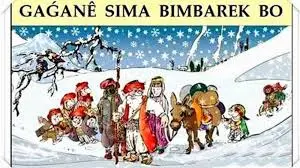
The most captivating element of the ritual is the performative play Khal u Fatık (also called Khalkek), traditionally performed after sunset by three male characters and a musician. The first is Khal, an old, white-bearded man with a staff, who sometimes represents the figure of Khidr (Xızır), understood in Raa Haqi cosmology as a mystical earthly projection of the divine. His presence suggests deep religious symbolism. Khal carries a bundle and collects offerings from households he visits (Kul 2015).
The second character is Fatık (Fatma), Khal’s young and beautiful bride, played by a man in disguise, whose body is mostly covered except for her eyes. In some versions, she carries wool and a spindle. The third is Arab or Koçeg, often portrayed with blackened hands and face, possibly evoking racial caricatures, but more accurately represents a known local figure -a young, dependent companion traditionally brought along by pir or dede on village visits (Kul 2015).
The plot revolves around this trio visiting village homes. Khal is invited in, receives offerings, and a ritualized script unfolds where Fatık attempts to seduce the village youth through gestures and expressions. The young men try to abduct her, sometimes succeeding briefly. Khal and Koçeg intervene. If repeated, Khal dramatically “faints,” prompting Fatık to perform exaggerated revival gestures -such as squatting and symbolically urinating or fluttering her skirt over his face. Occasionally, Khal responds by striking Fatık or lying on her, actions interpreted as representing symbolic union or fertility. Khal’s fainting and reviving symbolise the death and rebirth of the old year, while Fatık embodies the vitality and promise of the new one (Gültekin 2019b).
As the play proceeds from house to house, the trio collects nuts, raisins, flour, and other goods. At each door, they say: Gağanê Sıma Bımbarek Bo! In Kırmancki (“May your Gağan be blessed!”). The items collected are often prepared in a communal meal, sometimes cooked in the poorest household or at a jiare and shared with the entire village -especially the poor. This communal meal has the structure of a ritual communion.
Dishes such as zerefet (a local yogurt-garlic-butter dish), pesare (a type of bread), and dane / dani (boiled wheat) are cooked. Sometimes, small sticks symbolising luck and prosperity are hidden in the food for participants to find. Leftovers are offered to livestock or placed near water sources to be later scattered over homes and animals as blessings (Kul 2015).
In some regions, Gağan gifts are exchanged -especially among children and neighbours. Women who have married and left the household are visited and presented with Bara Zeyiu -gifts considered their rightful share (Kul 2015).
The timing of Gağan -coinciding with the winter solstice around December 21- emphasises its function as a ritual of survival, renewal, and solidarity during the harshest part of the year. It serves as a rich and layered religious-social ritual that bids farewell to the old and welcomes the new through acts of community, symbolism, and sacred storytelling (Gültekin 2019b).
Anthropological Evaluation
Since the publication of Les rites de passage (The Rites of Passage, 1909) by the French ethnographer and folklorist Arnold van Gennep (1873-1957), one of the most important scholars of the formative and institutionalising period of anthropology, anthropologists-especially those working on small-scale communities-have shown a particular interest in initiation and various transition rituals. Gennep argues that rites of passage consist of three basic phases: separation, transition or liminality, and incorporation.
In the phase of separation, the individual or the community/society begins to shed the statuses acquired within culture. Various practices may symbolise this. In the phase of transition or liminality, the individual or the community has been stripped of previous statuses and roles, but has not yet acquired the new status and role. This stage is, in a sense, a condition of nothingness. In different cultures, this phase includes taboos, restrictions, and obligations that display rich variation. In many cultures, it is represented by symbolic death. For example, the Musahiplik Cem rituals practiced among Kurdish Alevi communities constitute one of the clearest examples containing the symbolism of rebirth. This cem ritual, which in itself and in all its stages is an initiation ritual, begins with the musahiplik ikrars through which unmarried men bind themselves to the brotherhood of Hak dina (the Batın world), one of the dominant elements of Raa Haqi cosmology. After the marriages in which they accompany one another as best men, there are various stages in some cem rituals of the Dersim region in which they participate together with their wives as couples, under a single white cloth symbolising the shroud (either lying on the ground or standing). Here, accompanied by the tarıq, used by the religious leader who conducts the cem and which may be defined as a kind of sacred relic or sacred staff, symbolic representations of dying and being resurrected are performed. After this process, the musahips gain the brotherhood of Neq dina (the Zahir world) and Hak dina (the Batın world). They then begin to live with a series of new cultural codes, statuses, and roles, above all a marriage prohibition that includes their own children, siblings, and cousins (Gültekin 2019b, 195-221).
On the other hand, Victor Turner (1920-1983), one of the leading figures of symbolic anthropology and an important theorist of contemporary anthropology, also developed significant perspectives on Gennep’s liminal phase. In The Ritual Process (1969), Turner constructs Gennep’s theory around the phase of transition/liminality, which he interprets as a process of passage between cultural structures. For Turner, the idea of stasis predominates in cultural structures. Transition, by contrast, expresses a process. Turner draws attention to the function of these processes in producing, at the level of symbols embodied by society/community, a condition of communitas. In this way, society/community renews its collective belonging and collective consciousness, emphasises solidarity, sanctifies an ideal wholeness in which statuses and roles disappear, and then social consciousness is refreshed as these return. The representations made visible through many mediations-such as the equality highlighted by the ritual, the trivialisation or even ridicule of relations of power and authority, the disappearance of hierarchy, and the insignificance of outward appearance-are practices that reproduce the reconstruction of the cultural world of society/community and the affective intensity directed toward integration (Gültekin 2019b, 195-221).
In the third and final phase, incorporation (or reaggregation), the individual or the community adapts to the new social position, status, and roles acquired after the transition process and assumes new forms of behaviour and relationality. At this stage, a new social position has been gained as a whole (Gültekin 2019b, 195-221).
Gağan rituals are not only a local New Year celebration specific to the religious calendar of Dersimli Kurdish Alevis. They are also the carriers of a rich and layered cultural memory that connects past and present, human and nature, old and new, death and rebirth. The themes of purification, solidarity, sharing, symbolic death, and resurrection that emerge in these rituals carry Gağan beyond an ordinary folk tradition and transform it into a rite of passage that keeps the community’s collective identity and memory alive. Evaluated from an anthropological perspective, Gağan both concretises the local counterparts of universal theories of rites of passage (Gennep’s structure of separation-liminality-incorporation and Turner’s concept of communitas) and plays a central symbolic role in the process through which contemporary Kurdish Alevism, and especially the diasporic generation in Europe, redefines itself. In this sense, Gağan is not only the farewell to the old year, but also a belief-time space in which the ethno-religious identity is reproduced and sacralised every year, and the past is carried into the future.
Conclusion
Gağan is far more than a local New Year observance specific to the religious calendar of Alevis of Dersim. It is a dense religious-social complex that brings together ritual, memory, symbolism, performance, and collective ethics within a sacred temporality of transition. Through fasting, Cem ceremonies, jiare visits, acts of purification, communal food sharing, gift exchange, and the highly symbolic Khal u Fatık / Khalkek play, Gağan ritually marks the passing of the old year and the arrival of the new. In doing so, it stages themes of death and rebirth, scarcity and abundance, danger and protection, separation and renewal.
Anthropologically, Gağan can be read as a striking local expression of the classical structure of rites of passage. Its ritual sequence contains clear elements of separation, liminality, and reintegration, while also generating what Victor Turner conceptualised as communitas: an intensified sense of solidarity, belonging, and collective renewal. During the ritual period, ordinary distinctions are symbolically suspended, the community is affectively re-bound to itself, and a sanctified transition is collectively enacted. In this sense, Gağan does not merely represent a calendrical threshold; it actively produces a social and cosmological passage.
At the same time, Gağan must be understood within the broader historical transformations of Dersimli Kurdish Alevi society. Although many of its traditional forms have weakened, the ritual has not disappeared. Rather, it has been re-signified under contemporary conditions and has gained renewed visibility, especially in Dersim and in the Western European diaspora. In this new context, Gağan has become one of the most powerful symbolic expressions of Dersimlilik, that is, of a micro ethno-cultural identity articulated at the intersection of Kurdishness and Aleviness but not reducible to either of them. Its revival in public performances, cultural events, and identity discourses shows that Gağan now functions not only as ritual continuity but also as cultural and political self-representation.
For this reason, Gağan should be approached as both an inherited ritual tradition and a living symbolic form through which contemporary Kurdish Alevis continue to interpret sacred time, reproduce collective memory, and negotiate identity. It is a ritual farewell to the old year, but also a yearly reactivation of belonging. In Gağan, the past is not simply remembered; it is ritually carried into the future.
Gezik, Erdal ve Hüseyin Çakmak. 2010. Raa Haqi – Riya Haqi: Dersim Aleviliği İnanç Terimleri Sözlüğü. Ankara: Kalan Yayınları.
Gültekin, Ahmet Kerim. 2020. Kutsal Mekânın Yeniden Üretimi: Kemerê Duzgı’dan Düzgün Baba’ya Dersim Aleviliğinde Müzakereler ve Kültür Örüntüleri. İstanbul: Bilim ve Gelecek Kitaplığı.
Gültekin, Ahmet Kerim. 2019a. Kurdish Alevism: Creating New Ways of Practicing the Religion. Working Paper Series of the HCAS “Multiple Secularities – Beyond the West, Beyond Modernities,” no. 18. Leipzig: Leipzig University.
Gültekin, Ahmet Kerim. 2019b. “Dersimli Alevilerde Khal Gağan Ritüelleri.” İçinde Dersim – Üç Dağ İçinde, 195-221. Ankara: NotaBene Yayınları.
Gültekin, Ahmet Kerim. 2016. “Gağanê Sıma Bımbarek Bo! – Gağanınız (ya da Noeliniz) Kutlu Olsun!” Bilim ve Gelecek, sayı 144: 69-71.
Kılıç, Ali. 2009a. “Festivale Gağane Ma Sero I.” Munzur Etnografya Dergisi, sayı 31: 43-61.
Kılıç, Ali. 2009b. “Festivale Gağane Ma Sero II.” Munzur Etnografya Dergisi, sayı 32: 35-54.
Kul, Ali Ekber. 2015. Dersim Bölgesinde Gerçekleştirilen Gağan ve Khalkêk Oyunu Bağlamında Seyreden-Seyredilen İlişkisi. Yayımlanmamış yüksek lisans tezi, Kadir Has Üniversitesi.
Muxindi, Seyfi. 2001. “Kalo Gağandi.” Munzur Etnografya Dergisi, sayı 9: 61-66.
Taş, Cemal. 2001. “Hard u Asmen.” Munzur Etnografya Dergisi, sayı 8: 65-70.
License information
© The Author(s). Unless otherwise stated, entries published in the Alevi Encyclopedia are licensed under a Creative Commons Attribution 4.0 International License.